Catalogue
of Making
This experiment looks at what happens when I slow a sketch down so much that the hand has time to interfere. Instead of showing an instant full-screen output, I make the image appear gradually so that every change of gesture has a consequence. Across three stages, I move from a simple binary switch to a woven, pixel-like surface that carries the timing, hesitation and interruptions of my hand.
The first sketch was a direct mapping of my hand: closed fist turns the whole screen white, open palm turns it black. It proved that the camera could read my gesture, but the output felt too clean. The screen only ever showed the present state, with no sense of how I got there or how long I held a gesture. Once I switched, the previous decision disappeared completely.
In the second sketch, the image builds line by line. At the start of each row, the current gesture decides whether that strip becomes black or white. The drawing now holds a record of my decisions: each band shows where I stayed, where I switched late, and where I hesitated. But the change only appears at the next row, so mid-row interruptions are still hidden inside the delay of the system.
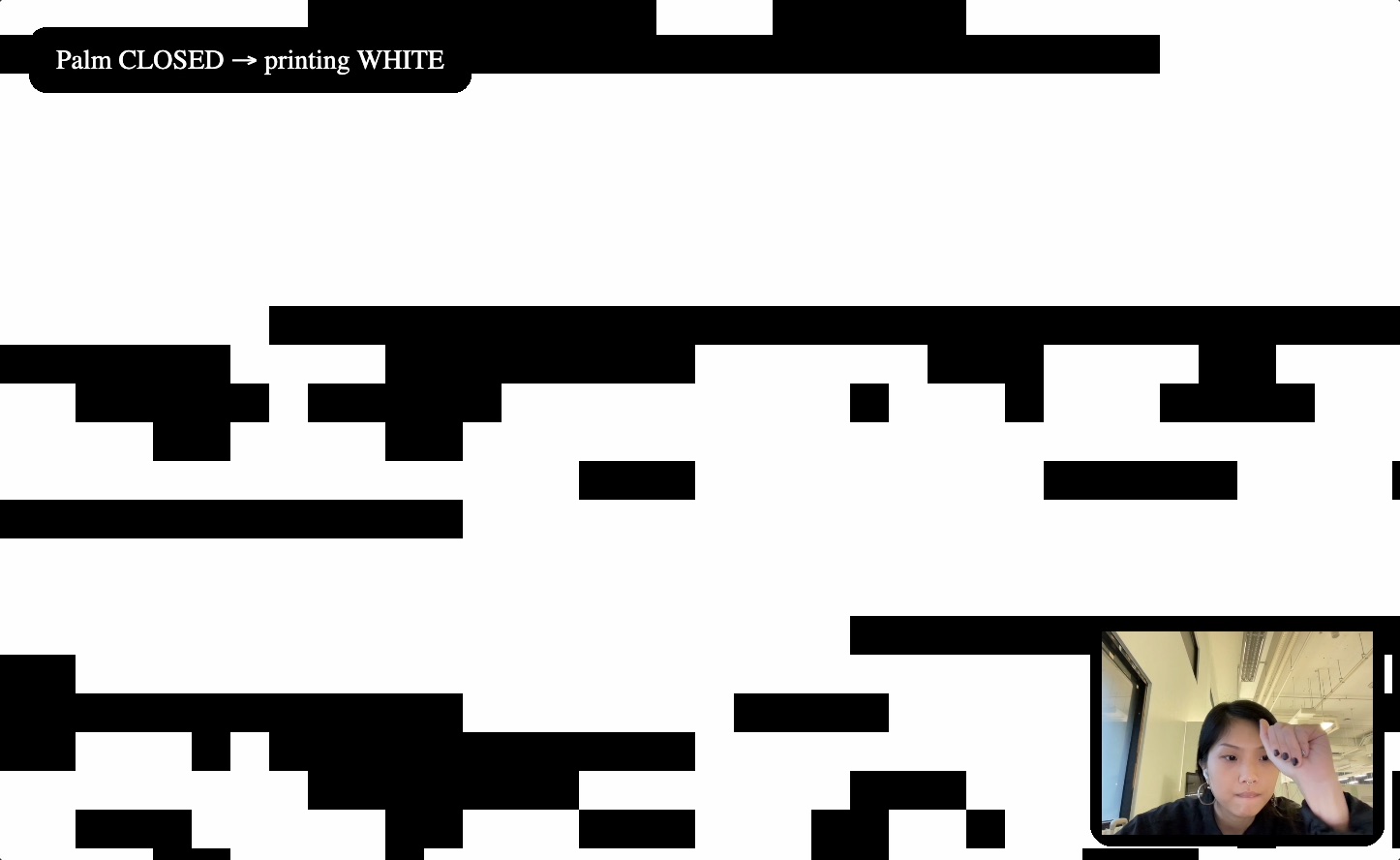
The third sketch moves from rows to pixels. Each block checks the hand state on its own, while the scan still travels left to right, top to bottom. This makes the final image feel almost woven: quick switches show up as speckled noise, and slow, steady holds become dense patches of tone. Waiting is still part of the process, but now every interruption is visible. My timing, mistakes and small bursts of impatience turn into the actual texture of the drawing.