WEEK 9
PROTOTYPE 2
Developing Prototype 2 with customisable behavioural-driven data
This week focused on improving Prototype 1 by introducing customisation features through p5.js. I began testing how pressure, hesitation, and reorientation could each be reinterpreted through adjustable visual logic.
System control and customisation
Testing how adjustable parameters can change how behaviour is interpreted.
Visual coherence of the glyph
Refining outputs so they feel structured, not random or overly expressive.
Geometric constraint and reconstruction
Using grids and modular forms to translate handwriting into a controlled system.
[ Experiment 6 ]
Separating behavioural signals into adjustable modules
Breaking the glyph into controllable parts
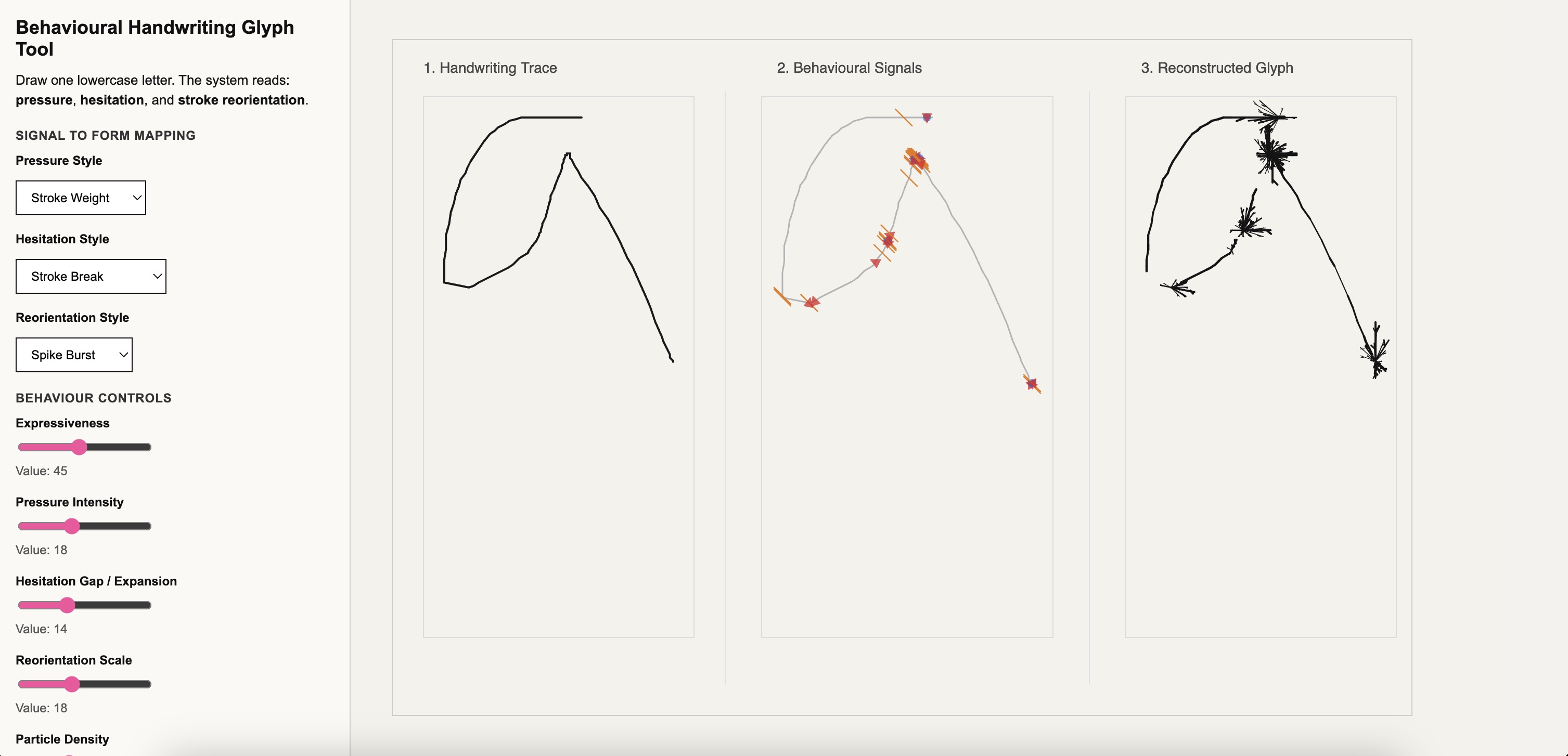
This was the first point where I stopped treating the glyph as one fixed output. I split pressure, hesitation, and reorientation into separate parts and tested how each could be controlled independently.
I also started introducing geometric logic here. Instead of drawing behaviour, I began organising it through simple forms and repeated rules. This shift moves the work away from expressive marks and toward a more system-based approach.
-
What worked
Separating the signals made the system clearer. It showed that behaviour can be structured and recombined rather than locked into one form. -
What did not
Too many options weakened the system. Some outputs felt arbitrary and less tied to the behaviour.
[ Experiment 7 ]
Consolidating into a single, more coherent glyph
Reducing variation to push one direction further
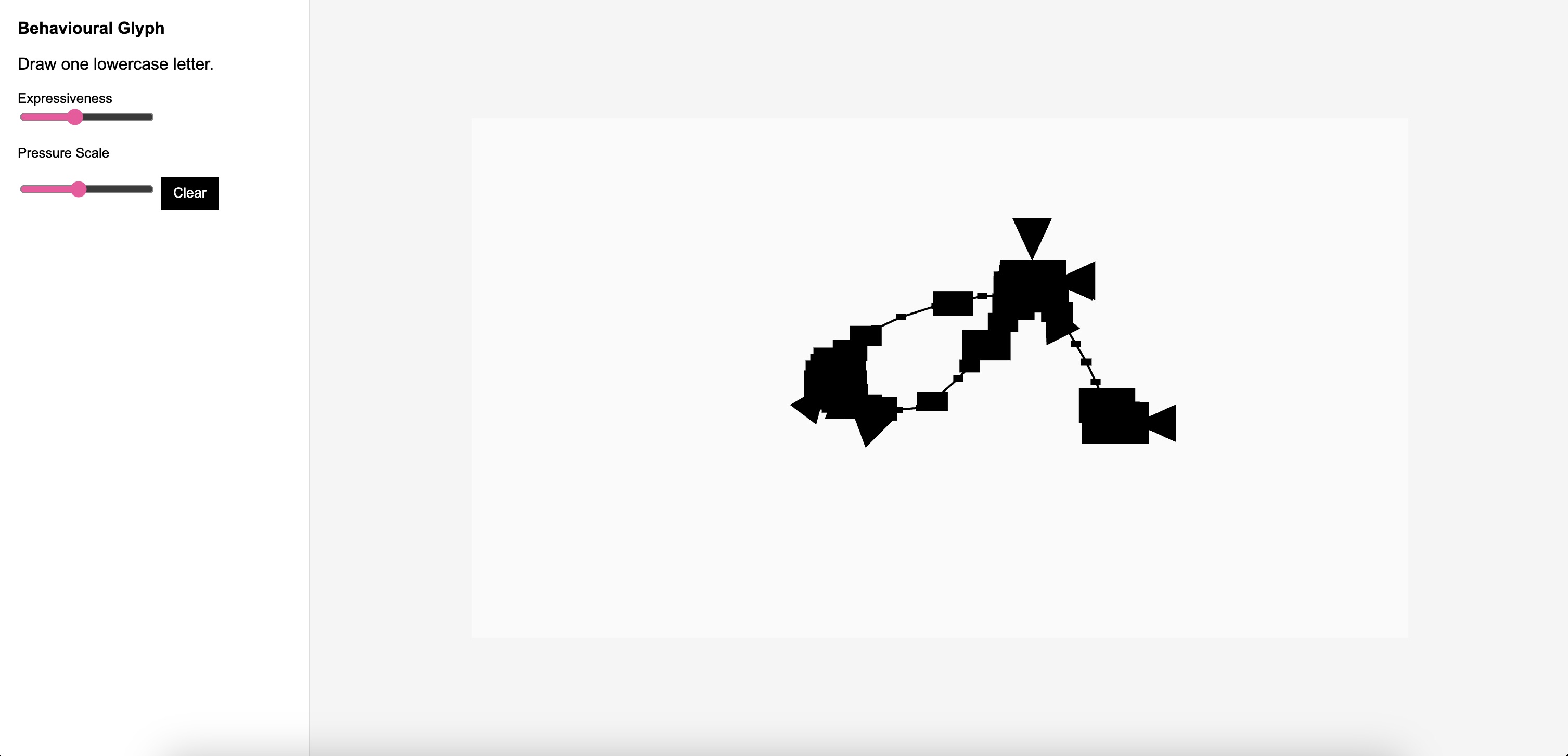
This experiment reduced variation and focused on one clearer mapping. Instead of testing many possibilities, I pushed one direction further. The glyph started to read as a whole. Behaviour was no longer a set of parts, but something shaping a single form.
-
What worked
The output felt more controlled and more like a glyph. The system started to feel intentional. -
What did not
Pressure still dominated the form. Hesitation and reorientation were present but less clear.
[ Experiment 8 ]
Building the glyph as structure
Constructing form through geometry
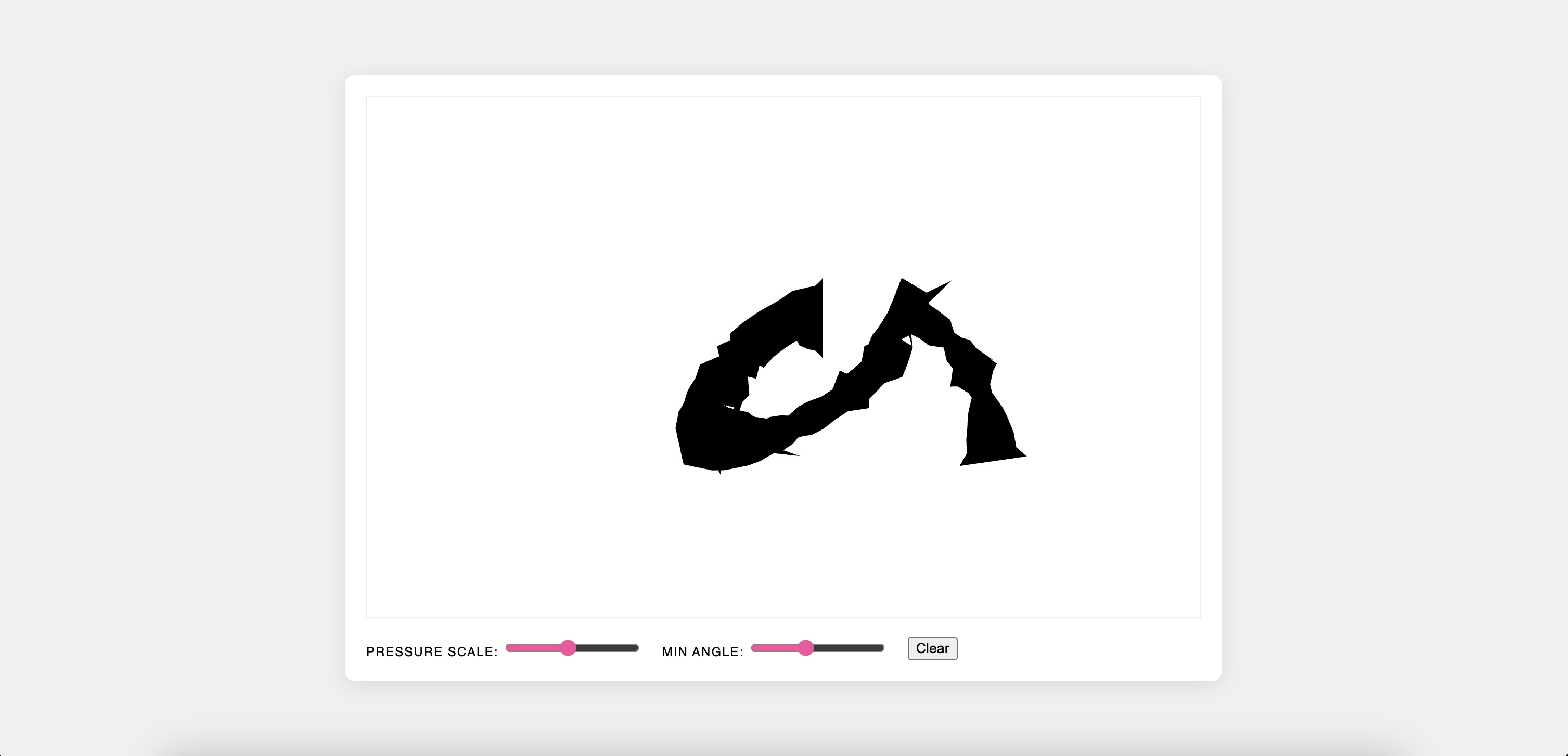
Here I stopped adding elements onto a stroke and started constructing the glyph itself. Pressure formed the body, hesitation created voids, and reorientation introduced directional shifts.
The move toward grids and geometry made the glyph less expressive and more constructed. It starts to feel like a system rather than a drawing. This loosely aligns with Bauhaus ideas of reducing form into simple, repeatable structures.
-
What worked
The glyph felt more constructed and less decorative. Behaviour became part of the form itself. -
What did not
The link between behaviour and output became harder to read. It needs clearer communication.
[ Prototype 2 / Experiment 9 ]
Prototype 2
A more adjustable and sequential behavioural system
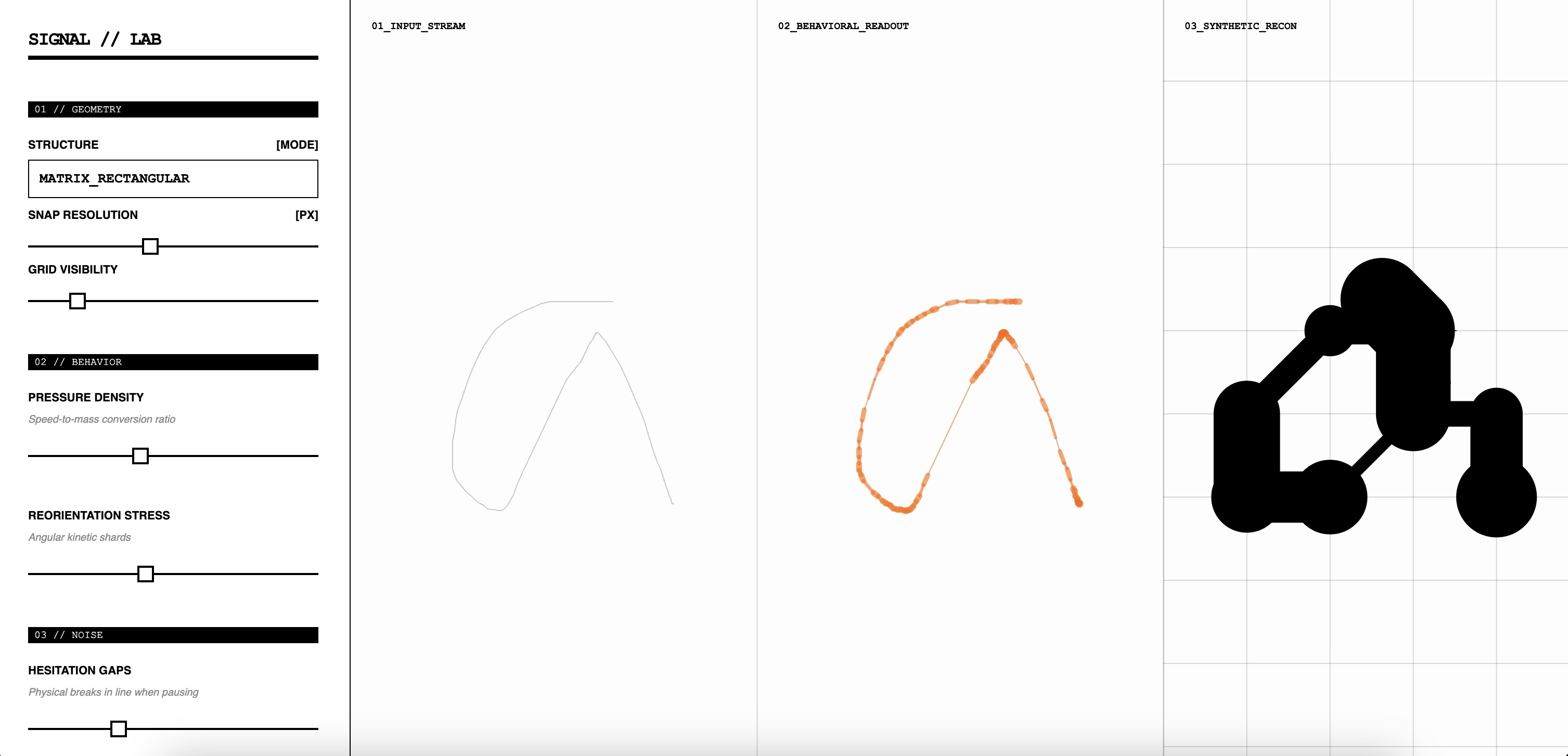
-
1) Behavioural capture and readout
The system records pressure, hesitation, and reorientation in real time and displays them as measurable signals rather than visual traces. -
2) Customisable reconstruction controls
Users can adjust how each behavioural signal is translated through parameters such as density, gaps, stress, and drift. -
3) Grid-based reconstruction modes
Rectangular, circular, and triangular grids constrain the glyph, producing different geometric interpretations of the same input. -
4) Structured interface flow
The interface is organised into input, behavioural readout, and reconstruction, making the transformation process visible and sequential.
[ Reflection on Prototype 2 ]
What shifted
From accurate capture to authored reconstruction
Prototype 2 marks a shift from producing a single output to building a system that can be adjusted and tested. The same handwriting input can now generate different results depending on how each behavioural signal is interpreted. This made it clearer that the project is not about capturing handwriting accurately, but about constructing a new reading of it.
The introduction of grids also changed how the glyph behaves. Instead of following the original trace closely, the form is reorganised through geometric constraint, making the output feel more deliberate and less dependent on the original drawing.
At the same time, the system is still uneven. Pressure continues to dominate the overall form, while hesitation and reorientation are less visible unless adjusted carefully. The controls also require more clarity, as it is not always obvious how each parameter affects the outcome. While the prototype feels more structured and intentional, it still needs refinement in balance and usability.
[ Reflection ]
Breaking the system revealed how behaviour can be structured
Separating signals made it clear that behaviour is not one thing, but multiple layers that can be controlled.
[ Reflection ]
Constraint made the output stronger
Introducing geometry and grids helped stabilise the glyph and reduced unnecessary variation.
[ Next step ]
Designing the full interaction system
I need to plan how users move through the tool clearly, from input to output, and how each control supports understanding rather than confusion.