WEEK 5
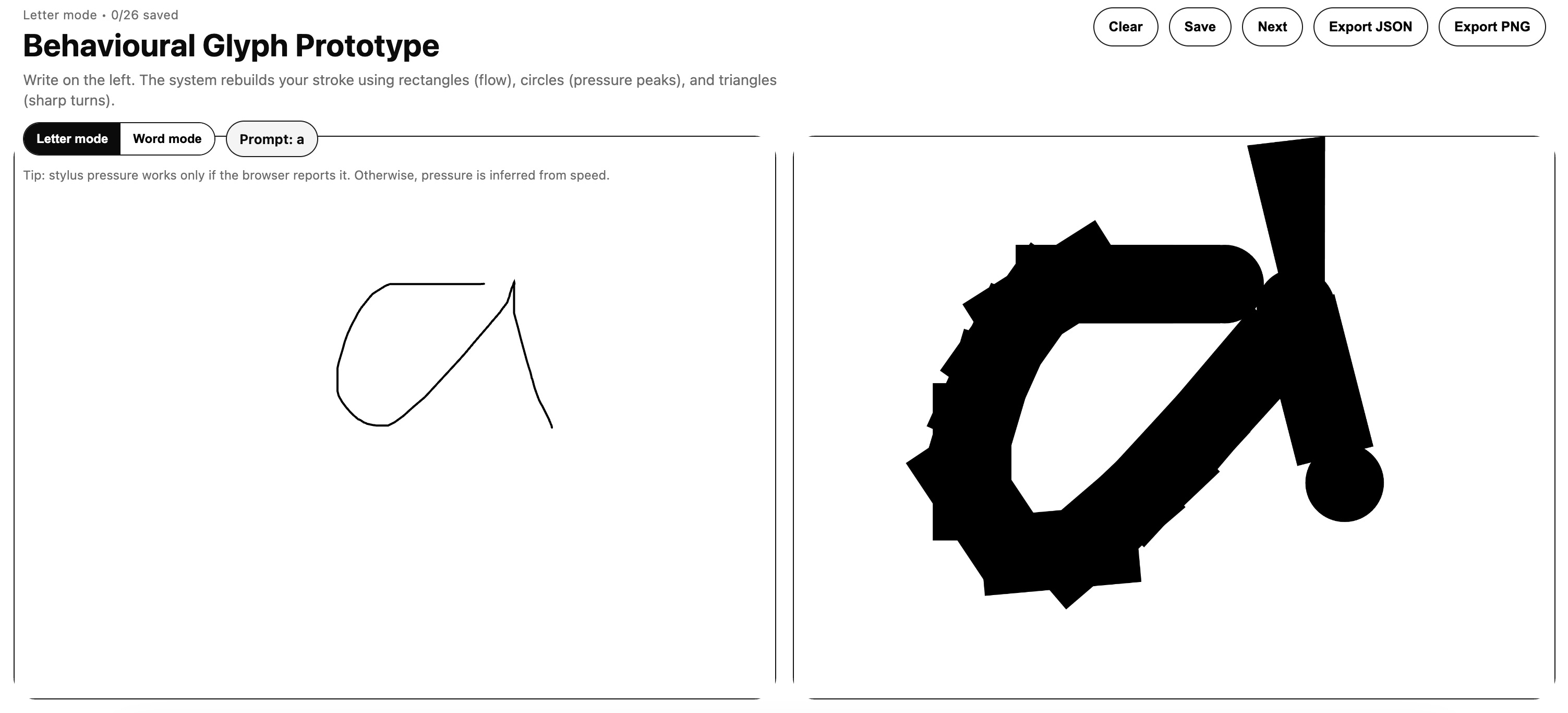
FROM PRESERVATION TO RECONSTRUCTION
When the system starts deciding what counts as behaviour
Up to this point, the system preserved writing behaviour. It replayed order and exposed sequence. This week marked a shift in the project, the system began deciding what counts as behaviour.
New move
Introduce shapes to represent behavioural signals.
Key mechanism
Introduce thresholds (rules) to discretise continuous gesture.
Outcome
A coded system that reconstructs behavioural traces into glyph form.
[ From gesture to detectable form ]
Why thresholds matter
A system needs a definition of “significant”
Handwriting is continuous. Pressure shifts gradually. Speed fluctuates subtly. Direction curves fluidly. But for a system to respond, it must decide when behaviour becomes significant.
- When does pressure become emphasis?
- When does slowdown become hesitation?
- When does turning become reorientation?
At the same time that I defined these behavioural signals, I also defined their geometric responses. Detection and reconstruction were not separate stages. They were developed together. I finalised three behavioural signals and their corresponding forms:
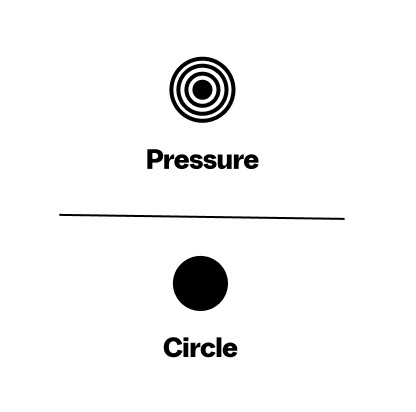
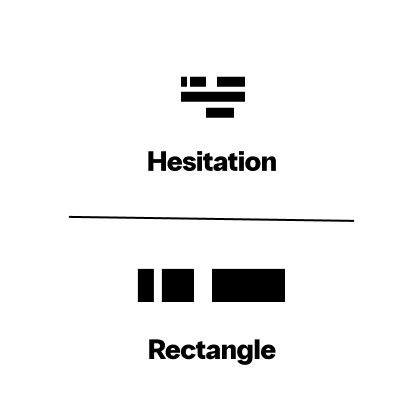
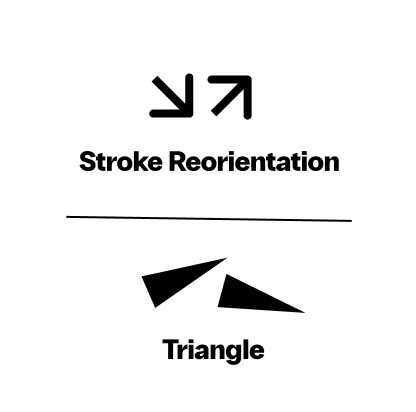
Rectangles form the stroke backbone. All shapes share a consistent base width proportional to glyph height. This constraint keeps the system unified even when behaviour varies. As the system detects, it constructs. As behaviour is segmented, geometry appears. This is where the project shifts from observing gesture to rebuilding it through rule-based form.
[ Manual test ]
Manual test — letter “g”
Proving the concept before coding it
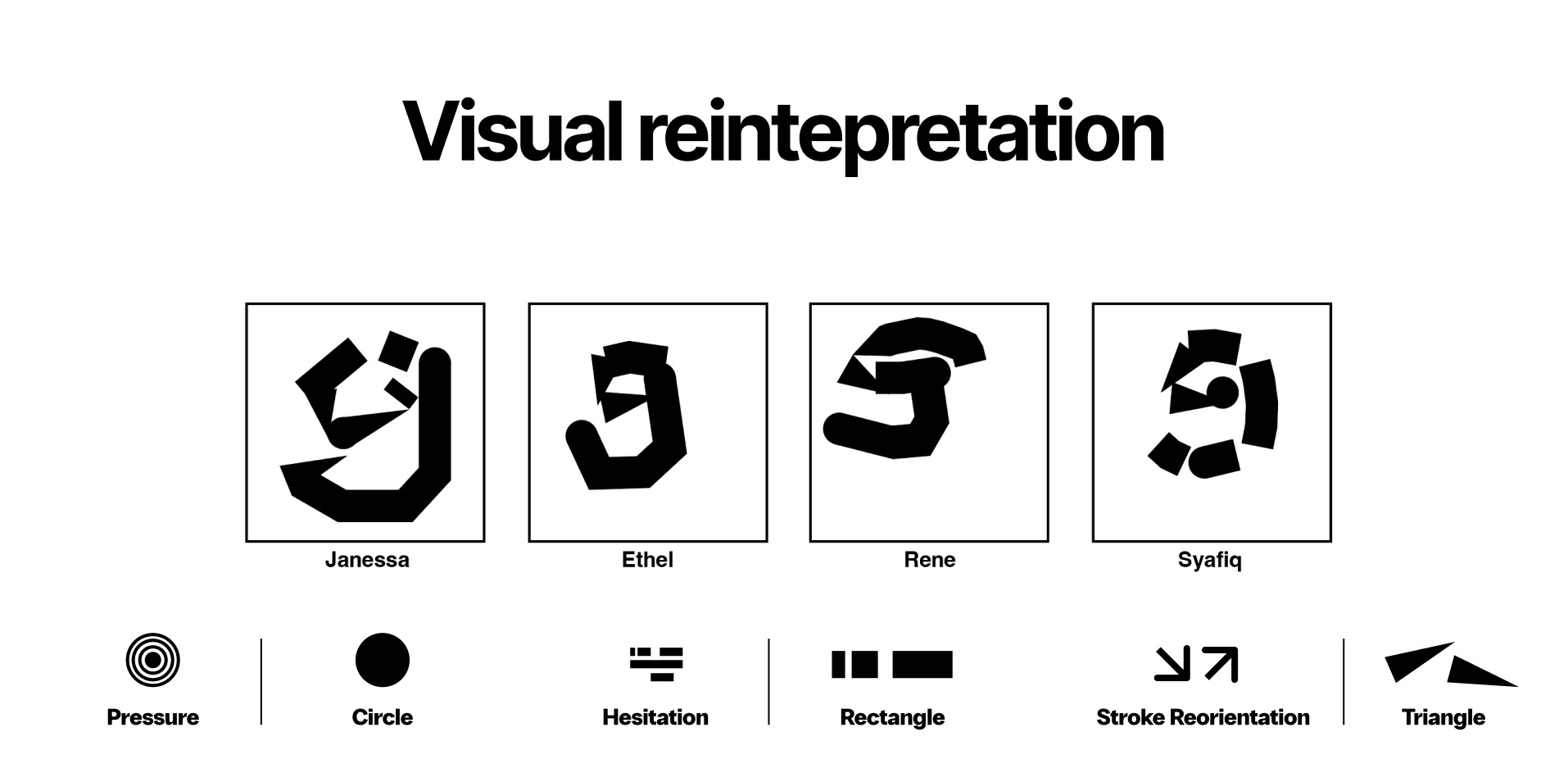
Before coding the logic, I tested the idea manually. I asked three friends and myself to write the letter “g” using a Wacom tablet. I recorded the traces and manually analysed them in Photoshop. Using my own logic, I placed:
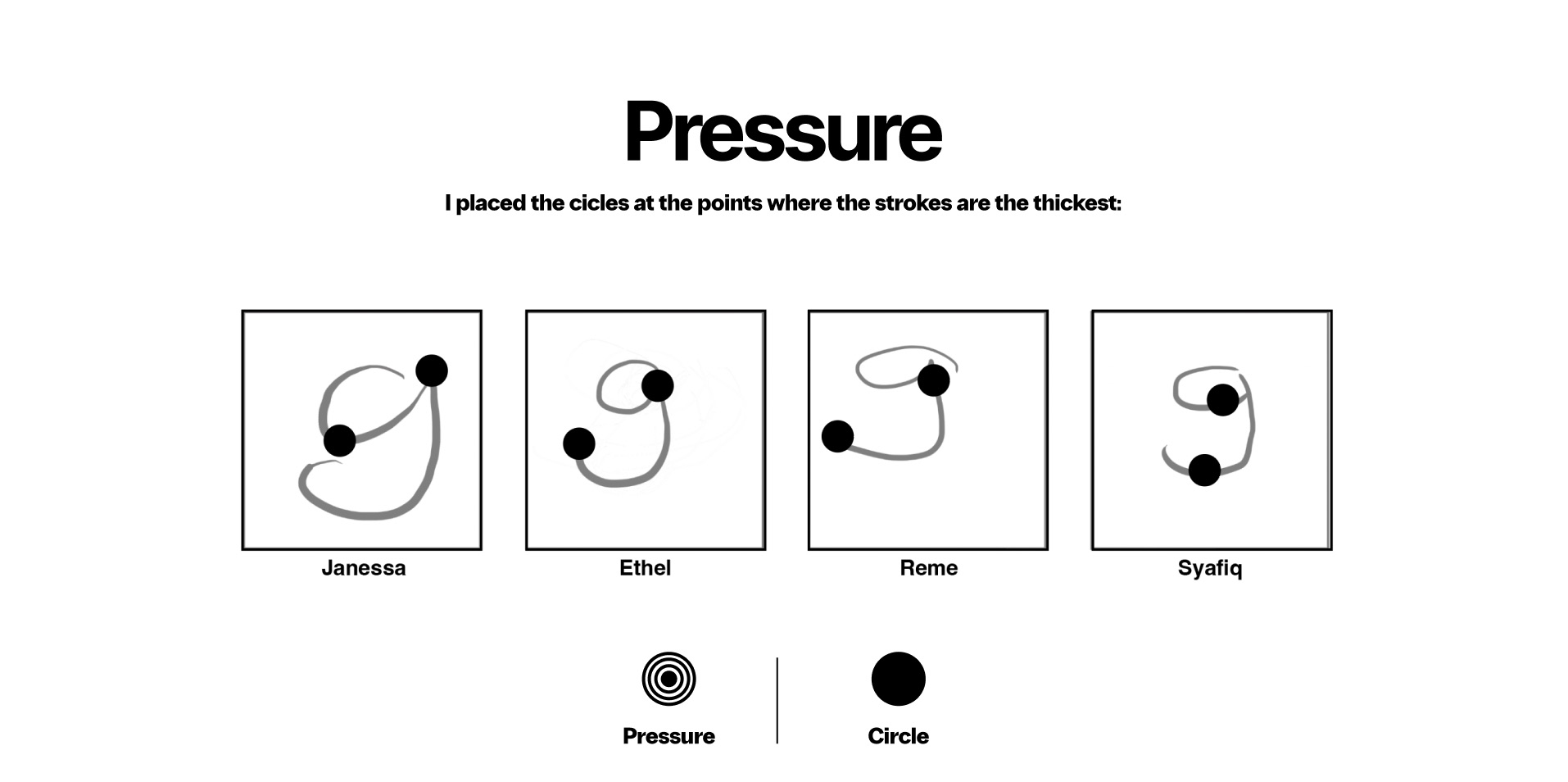
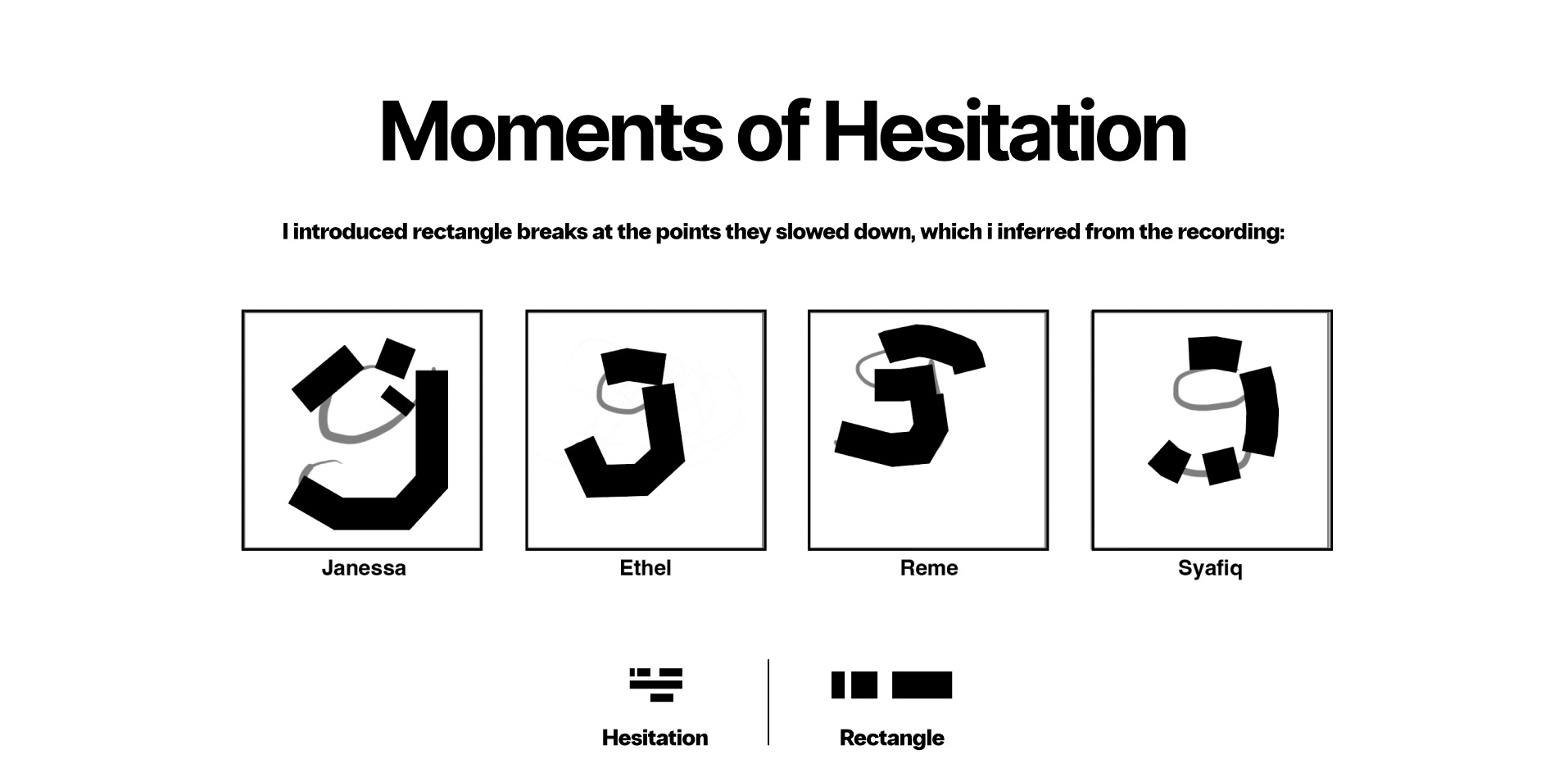
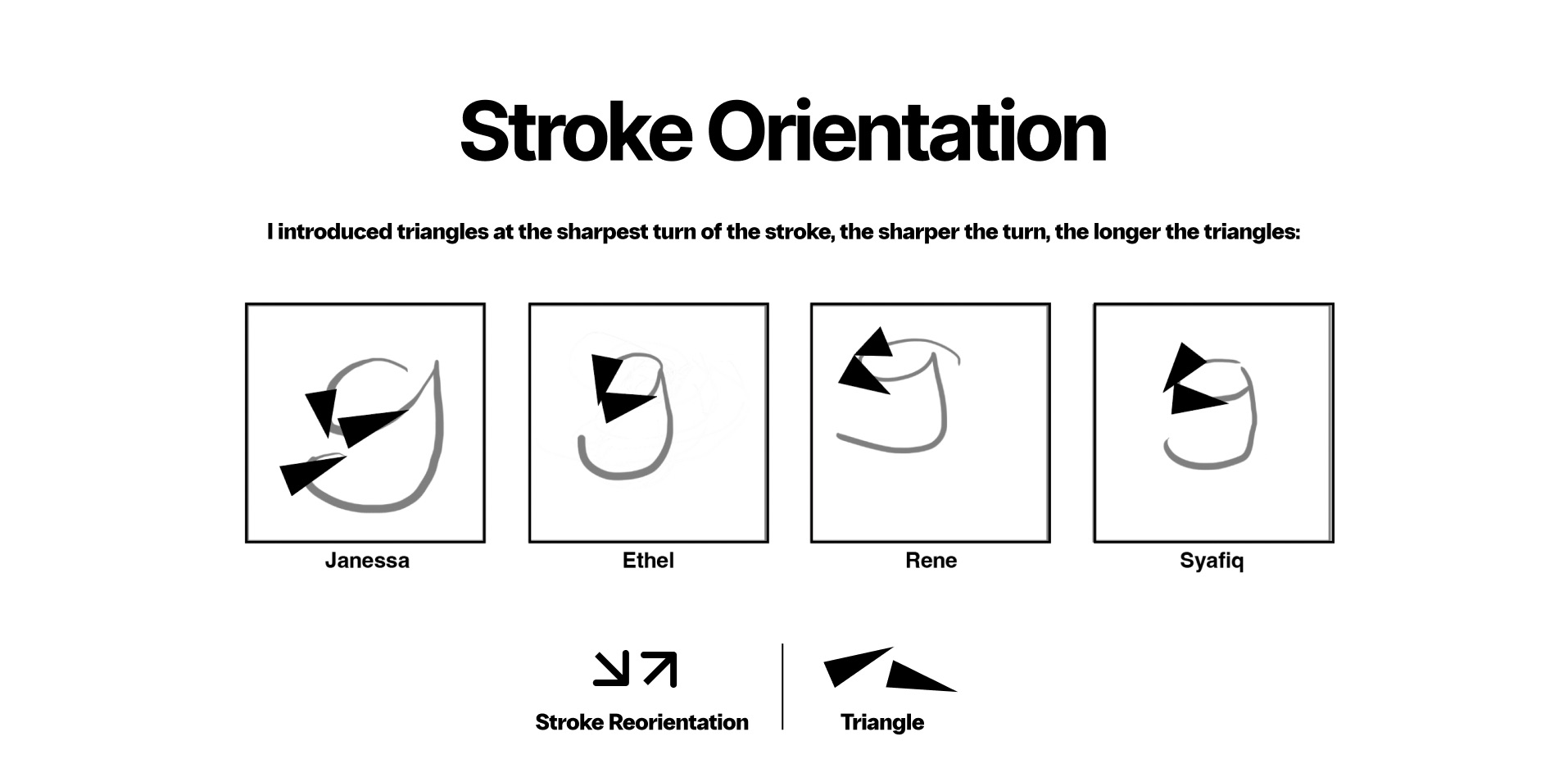
The idea worked conceptually before it worked computationally. This was the first time the glyph idea felt like it had potential. This manual mapping confirmed two things:
- The three behavioural signals were visually identifiable.
- Different writers produced different behavioural patterns, even when writing the same letter.
[ Threshold logic ]
Introducing thresholds
Discretising continuous behaviour
The next step was to make the system detect these behaviours automatically. I implemented thresholds:
- Pressure peaks
relative to the writer’s
baseline pressure - Hesitation
relative to mean
writing speed - Reorientation
based on angle
change threshold
[ The first glyphs ]
Breakthrough + friction
Coherence mattered more than perfect accuracy
The first threshold-based outputs were slightly chaotic. Some detections were off. Some shapes overlapped awkwardly. It took several adjustments. But when I tested it on my own handwriting and saw the glyph respond meaningfully, something shifted.
Realisation: The form was not perfectly accurate, but it was coherent. Mis-detections did not destroy the form. They altered it. That alteration felt interpretative rather than broken.
This was the breakthrough moment. Week 5 was a breakthrough because I finally formalised the system I wanted to build: a rule-based behavioural glyph engine.
[ Interpretation vs accuracy ]
Design stance
Choosing interpretation over optimisation
I began questioning whether the system needed to be accurate. Accuracy would mean perfectly replicating pressure, timing, and motion. That would shift the project toward engineering optimisation.
Instead, I chose interpretation. The algorithm is authored. It follows my rule set. It translates behaviour into a geometric language. If behavioural signals are legible but the original letter becomes less readable, that is acceptable. Behaviour is prioritised over letterform.
The system is not reproducing handwriting. It is reconstructing behavioural traces.
[ What the user learns ]
Behavioural mirror
What becomes visible through the glyph
When users test the system, they begin to notice:
- Where they press harder
- Where they slow down
- How their curves differ from others
- Where they pivot sharply
The glyph becomes a behavioural mirror. I also want users to compare outputs between writers. Writing the same letter should produce different glyphs. The variation is the point.
[ Reflection ]
From showing to deciding
Week 4 revealed writing order. Week 5 introduced thresholds. The system now determines what counts as behavioural events.
[ Reflection ]
Formalising behaviour
Continuous gesture became discrete signals. Pressure, hesitation, and turning were defined through rules rather than intuition.
[ Reflection ]
Beginning the glyph system
The first threshold-based glyph confirmed the system works. Handwriting is no longer replayed, but reconstructed through interpretation.