WEEK 4
PRESERVATION AS OPPORTUNITY
Making procedure visible
Week 4 focuses on preserving writing order as a way of revealing procedural traces in handwriting. Rather than expanding into multiple parameters, I decided to isolate one and test it clearly. This week is asking: What happens if the system simply preserves how writing was constructed?
Parameter
Writing order (stroke sequence).
System mode
Preserve, not reinterpret.
Outcome
Expose procedural traces that static handwriting collapses.
[ Mapping opportunities ]
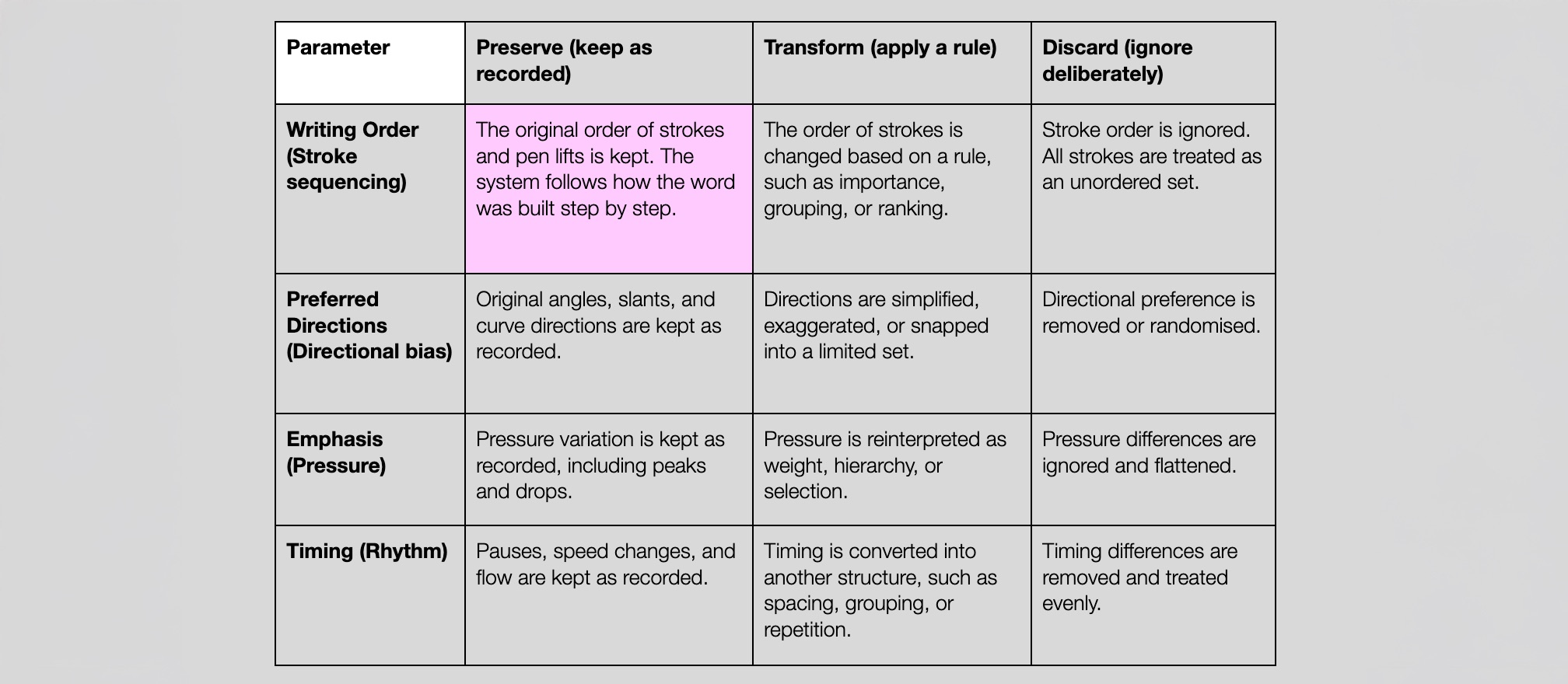
Exploratory grid
Preserve / Transform / Discard
Before building Experiment 03, I created a grid to explore possible directions. The parameters were not finalised. They were working keywords to help identify where conceptual potential might lie.
[ Gesture parameters (exploratory keywords) ]
- Writing order
- Preferred directions
- Emphasis (pressure)
- Timing (rhythm)
Each parameter was mapped against three system strategies: Preserve, Transform, and Discard. The goal of this grid was not to implement everything, but to visualise possible areas of focus.
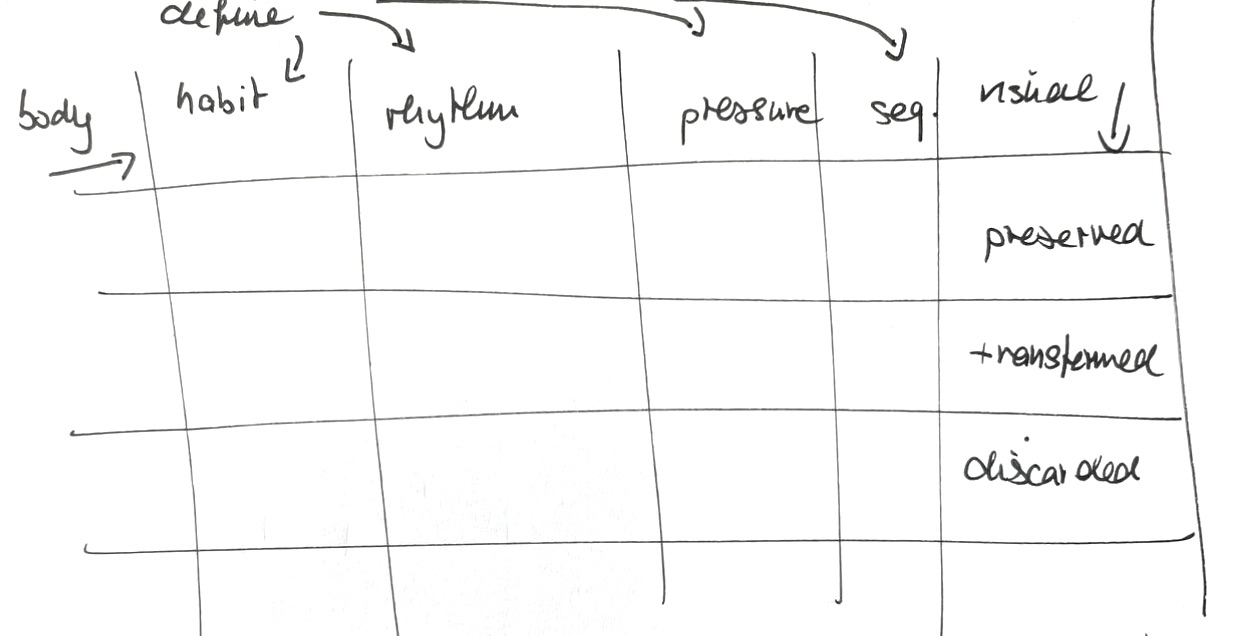
From this mapping, I decided to focus on preserving writing order.
[ Why writing order ]
Procedural trace
Handwriting as step-by-step construction
Writing order is procedural. Procedural refers to how the action is constructed step by step, rather than what the final result looks like. Two people can write the same word and produce similar shapes, yet construct it differently.
- Begin from different points
- Break strokes differently
- Lift the pen at different moments
- Retrace in different directions
Writing order captures decision-making over time. It reveals how the body builds the letter. This made it conceptually clear and measurable, which is why I chose it as the first parameter to test.
[ Experiment 03 ]
Preserve writing order
Making stroke sequence legible
Aim
This experiment investigates writing order as an embodied procedural trace. The objective was to test whether making stroke sequence visible would reveal differences normally collapsed into static handwriting.
What I built
I developed a p5.js prototype using a Wacom tablet. The interface is split into two panels:
[ Observations ]
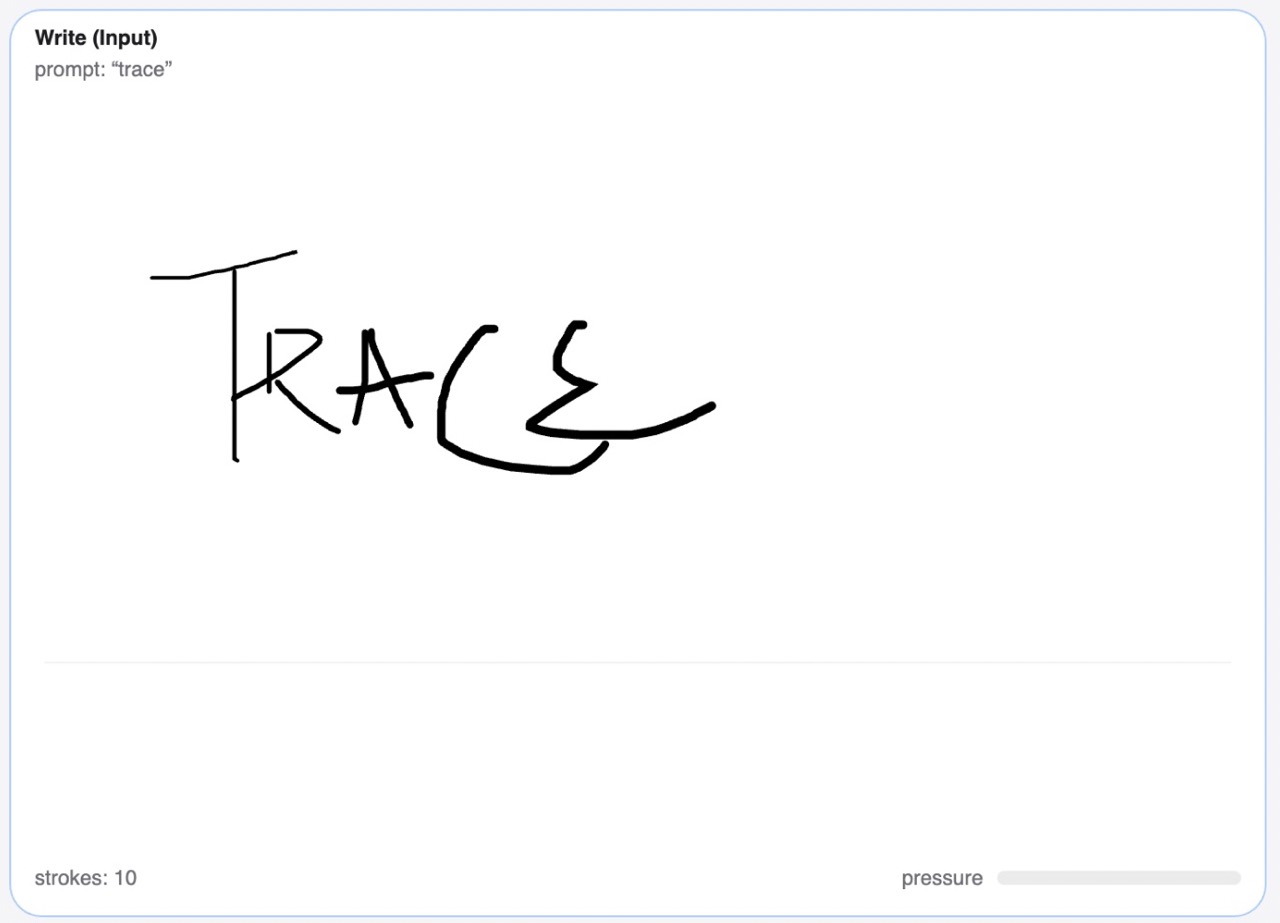
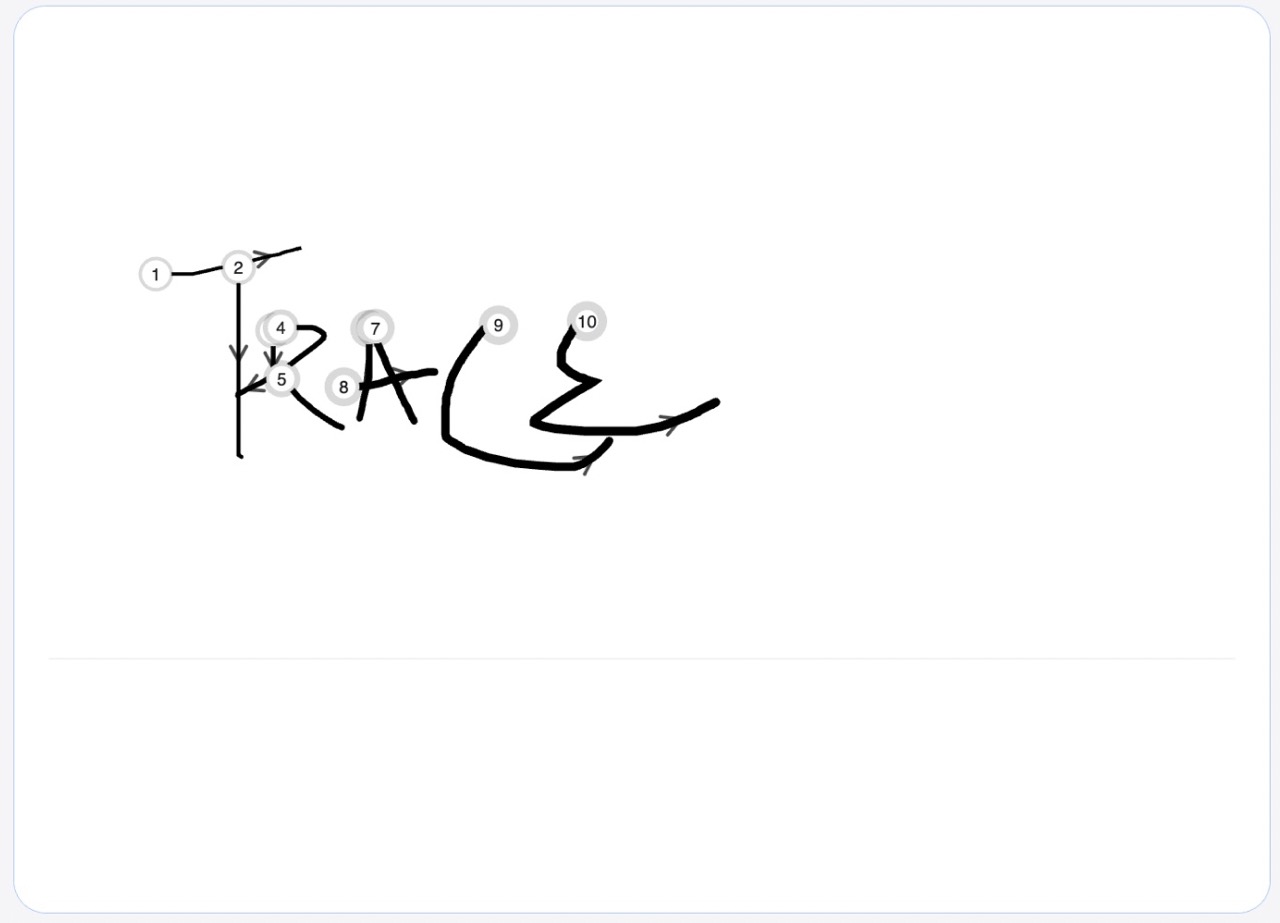
Left: Plain handwriting input | Right: System view preserving stroke order
The system captures strokes from pen-down to pen-up events. Each stroke records:
Position
x, y
Time
sequence + duration
Pressure
stylus force
In Preserve mode, the system:
Keeps stroke order exactly as recorded
Replays strokes in sequence
Displays directional arrows
Labels stroke starts with numbers
Ignores spelling, meaning, and neatness
The right panel does not reinterpret. It exposes.
-
Arrows > numbers
Directional arrows significantly improved clarity. Numbers alone were not immediately legible. -
Split-screen clarity
The layout helped communicate that the system was not correcting the writing, but reading it differently. -
Habit awareness
Participants noticed unconscious habits, like consistent start directions or unexpected segmentation.
[ Positive reaction from classmates ]
Shift in method
During presentation, people responded strongly to the directional arrows. They commented that they became aware of habits they had never consciously noticed, such as always beginning strokes from a particular direction or breaking letters into unexpected segments.
[ Reflection ]
Look into thresholds
It preserves raw procedural data. There are no threshold conditions yet. No segmentation rules nor behavioural event detection. This week remains within Preserve mode, but i have to look into threshold for my next prototype.
[ Reflection ]
What kind of threshold?
Look at what threshold I can set for pressure, moments of hesitation, stroke reorientation. How? look for specific theoratical readings on motor behaviour of handwriting.