WEEK 3
NARROWING THE GESTURE
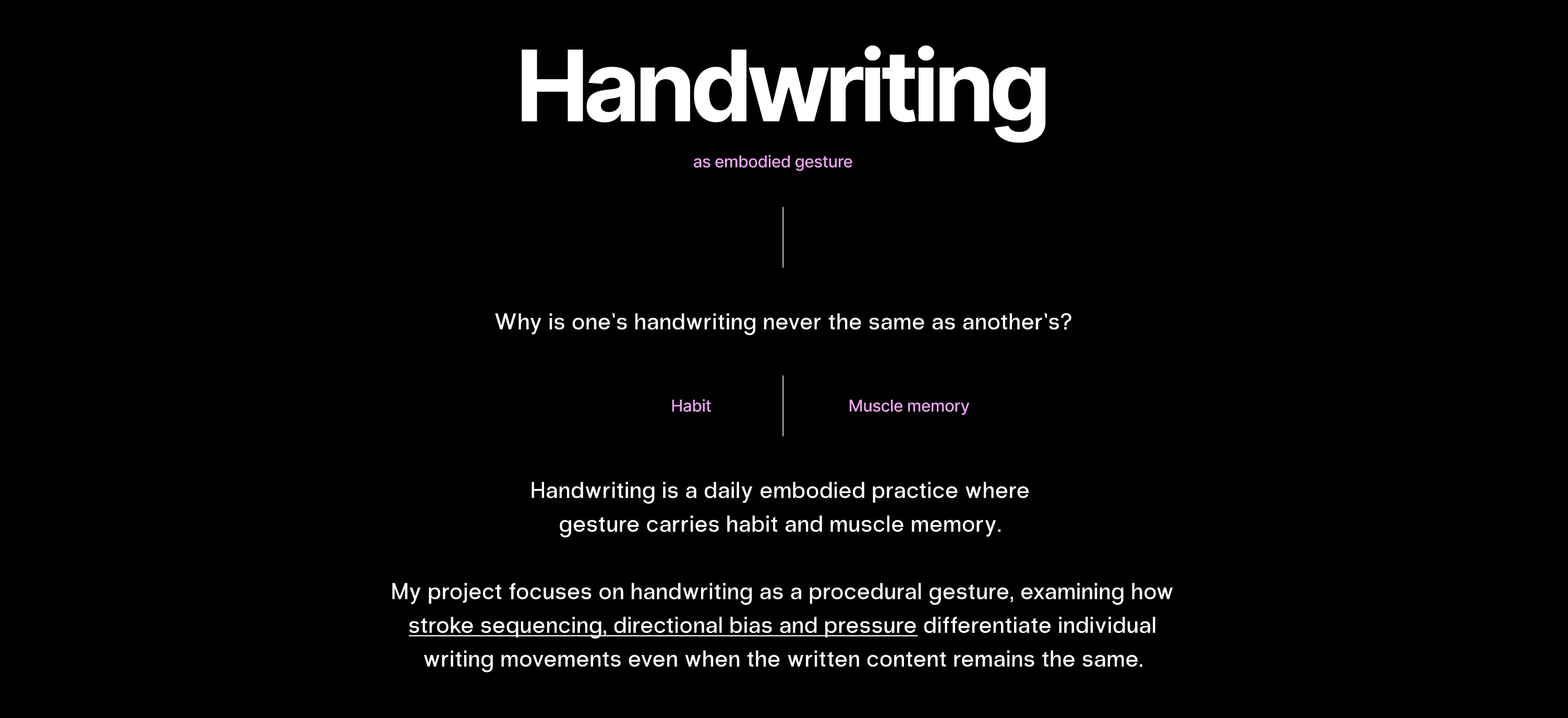
Finalising handwriting as gesture
I narrowed the gesture down to handwriting and treated it less as written form, and more as structured movement over time. That decision shaped Experiment 02, where I tested how system can extract behaviour and reorganise it into a new structure.
Decision
Shift from calligraphy as tradition to handwriting as daily motor behaviour.
Experiment
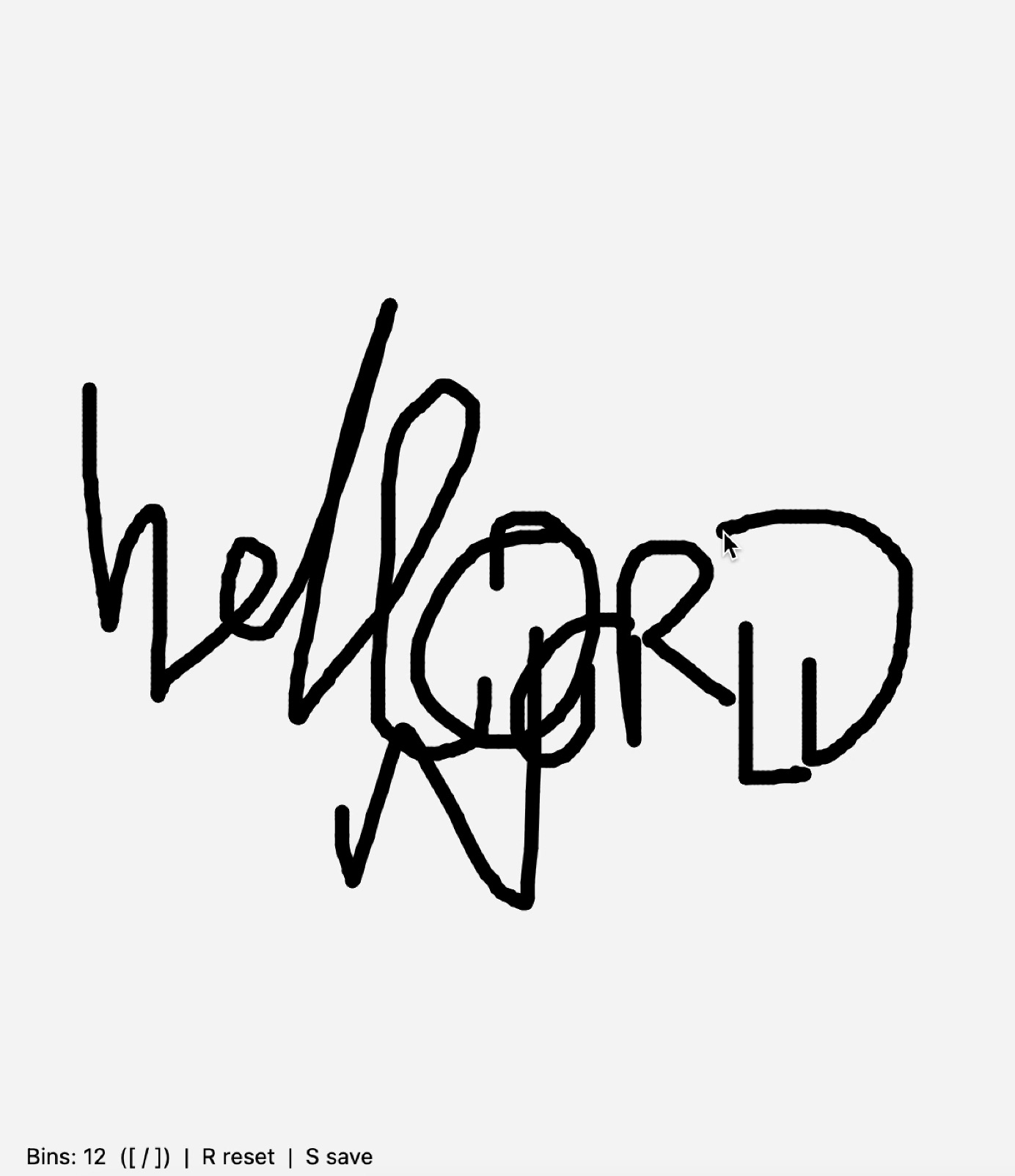
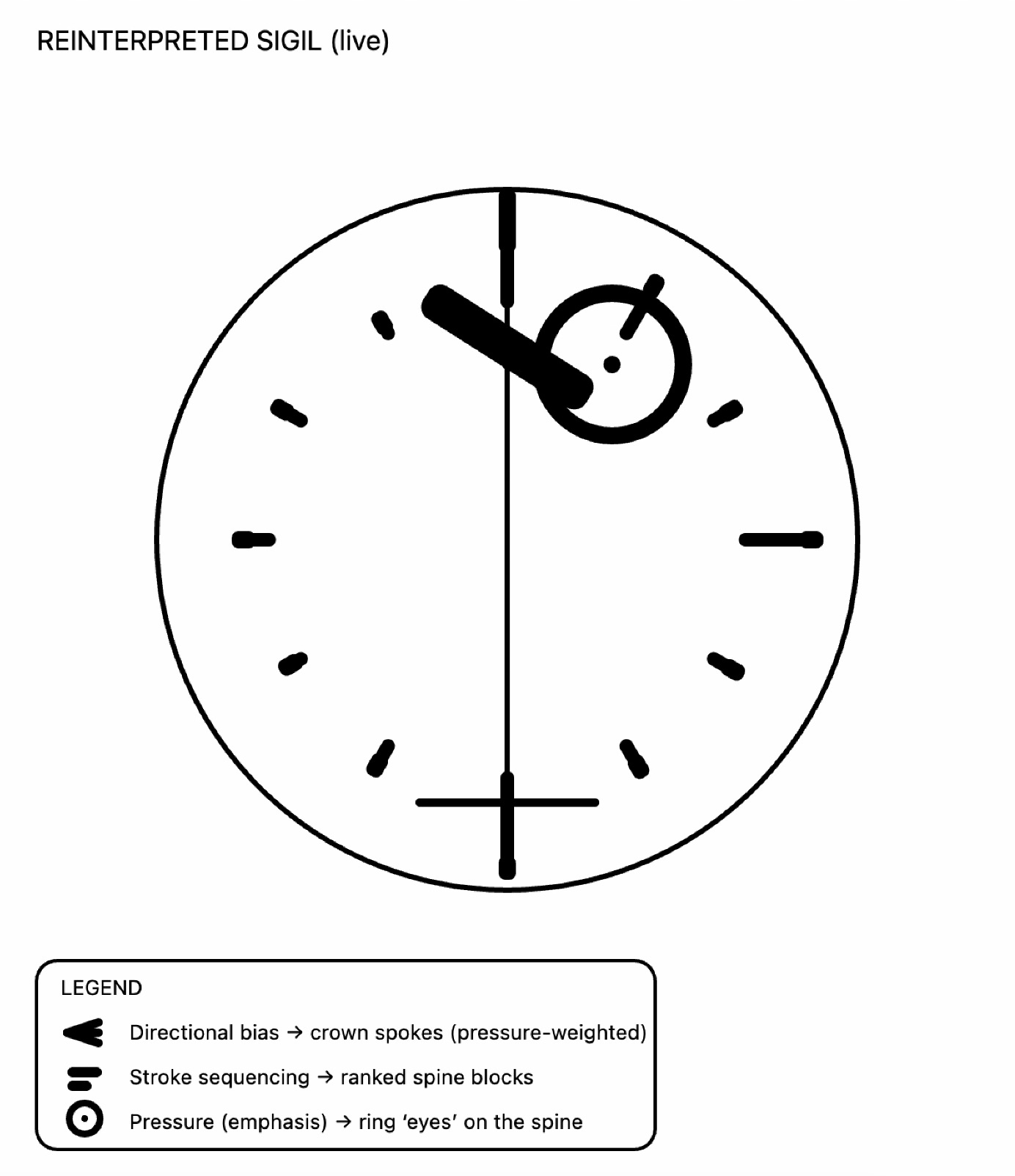
Sigil prototype: left is trace, right is rule-based reinterpretation.
Tension
Behavioural abstraction is clear, but reconstruction is still more expressive than conditional.
[ Reframing ]
From calligraphy to handwriting
Treating writing as motor behaviour
I initially approached this project through Chinese calligraphy. I was interested in stroke order, pressure, and rhythm, and how these embodied qualities might shift when recorded digitally. My questions were:
-
01 Reinterpretation
If I record calligraphy digitally, how does computation reinterpret it? -
02 Preservation
What is preserved, and what is lost? -
03 Sequence
Which stroke comes first, and how does that matter?
Over time, calligraphy began to feel culturally specific and potentially limiting. It risked framing the project around a particular tradition rather than a broader investigation into gesture. I shifted toward handwriting. Handwriting is daily, habitual, and personal. It carries hesitation, speed, rhythm, pressure, and control, yet digital systems routinely flatten it into uniform text. From this point, I stopped treating writing as a cultural artefact and began treating it as motor behaviour.
- Handwriting is not just a visual trace.
- It is gesture structured over time.
[ Experiment 02 ]
Sigil prototype
Isolating interpretation before material translation
Why this prototype
Making the computational reading visible
I created this prototype to isolate interpretation. I wanted to test how a computational system chooses what to preserve, suppress, or distort before committing to any material translation. The focus shifted from surface aesthetics to extracted behaviour.
The interface is split into two panels:
How it works
Capture, derivation, reconstruction
The system operates in three stages.
-
01 Capture
Each stroke records x position, y position, and pressure. Handwriting becomes structured data rather than image. -
02 Derivation
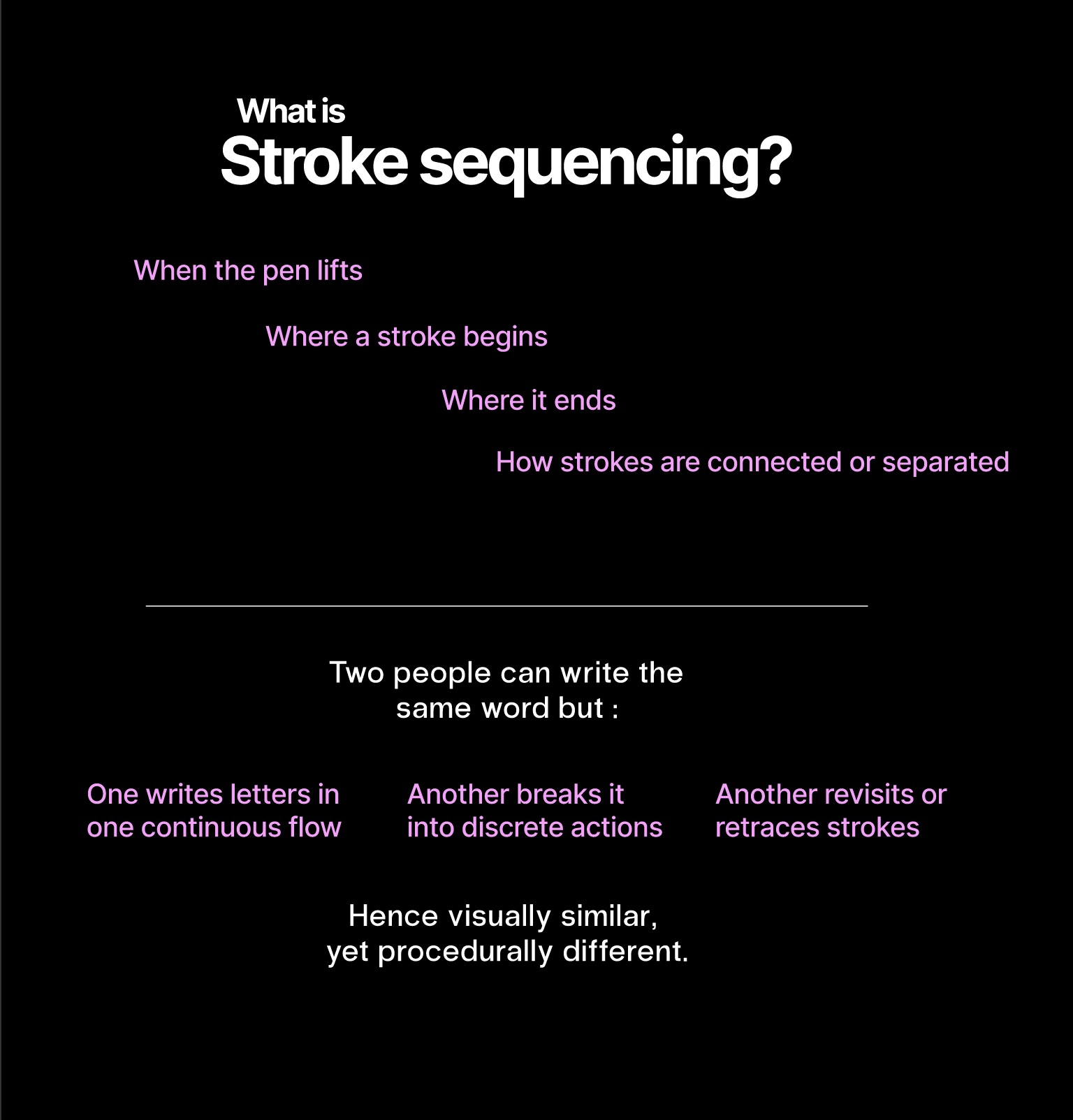
Peak pressure, stroke length, dominant direction, direction distribution (bins), and stroke sequence/ranking. -
03 Reconstruction
Behaviour reorganised as a sigil, compressing gesture into a symbolic structure rather than letterform.
The right panel reorganises features into a sigil:
- 01 Directional bias
→ radial crown - 02 Stroke sequence
→ vertical spine - 03 Pressure peaks
→ circular rings
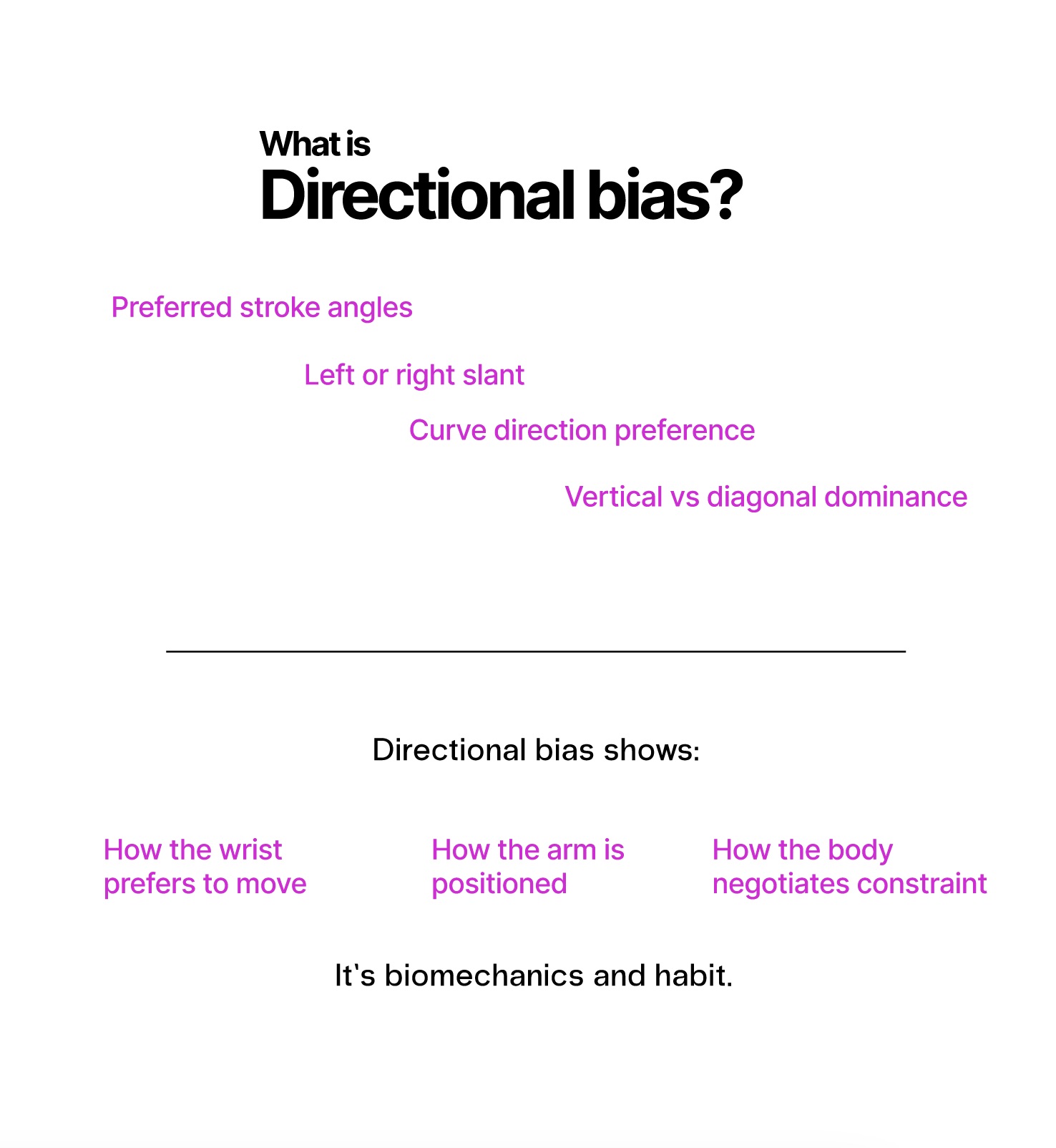
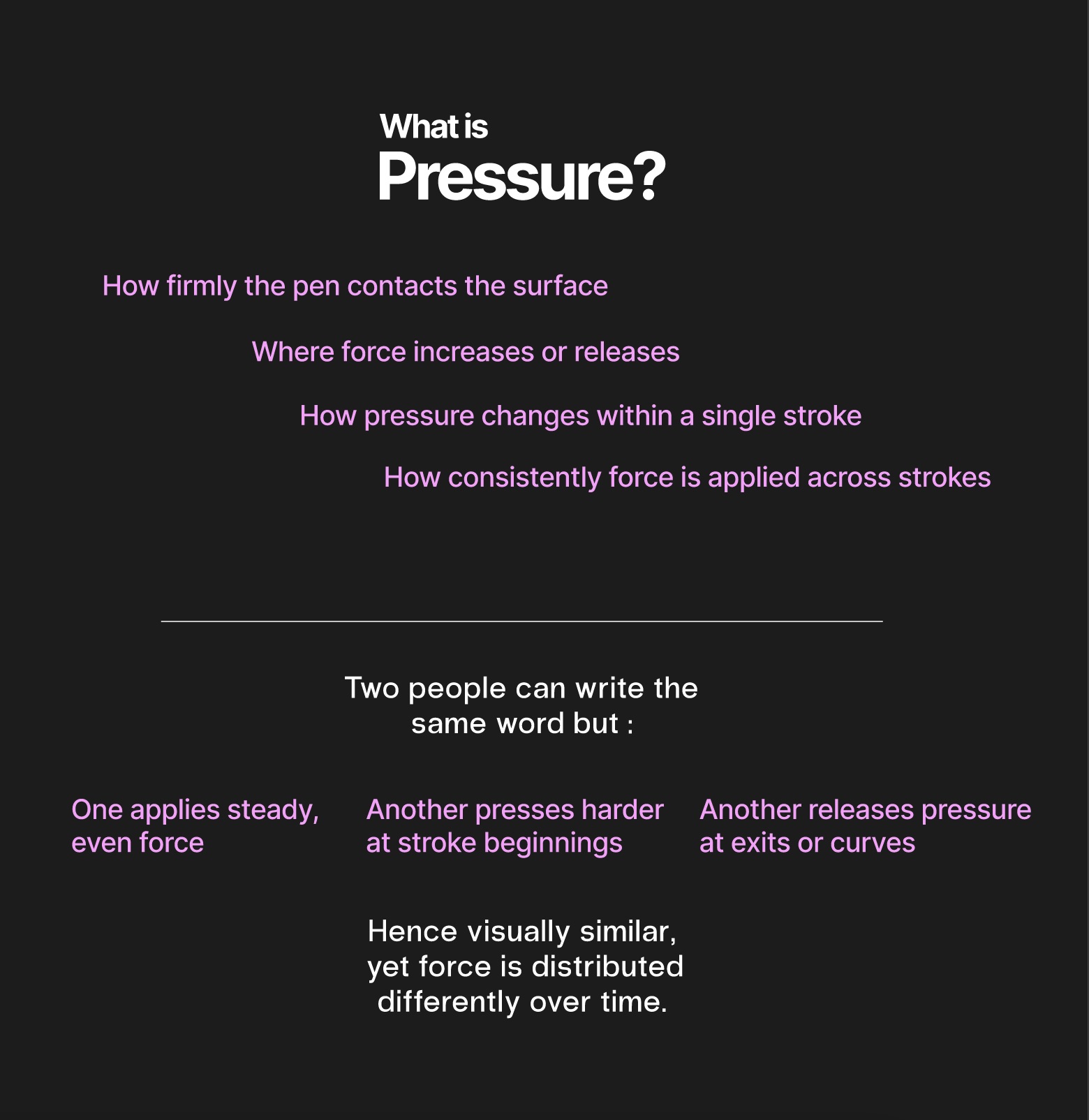
The output does not resemble the original letter. This is intentional. The sigil compresses behaviour into a symbolic structure.
What this experiment revealed
Behaviour can be extracted without preserving letterform
This experiment confirmed that behaviour can be extracted and reorganised without preserving letterform. However, the translation is still interpretative rather than conditional. The system measures features, but it does not yet operate through strict threshold rules. The reconstruction feels symbolic and expressive rather than structurally constrained.
This exposes a gap between behavioural abstraction and rule-based reconstruction. That gap leads directly to the later behavioural glyph prototype.
[ Feedback ]
Thursday (Andreas)
From interface to embodiment
- 01 If I am investigating gesture originating from the hand, consider hand tracking rather than only pen input.
- 02 If I choose to exclude the hand, that decision must be intentional and conceptually justified.
- 03 The pen only transfers movement. It does not fully represent the body that generates it.
- 04 Explore material translations beyond screen output. Try AxiDraw or a pen plotter to test physical reinterpretation.
- 05 Narrative presence of the maker must be clear (text, documentation, video, workshop format, staged performance).
- 06 Do not let the dissertation restrict experimentation. Loosen the structure slightly and explore.
Reflection
Hand → code → machine → output
This feedback shifted my focus from interface design to embodiment. It made me question whether I am studying handwriting as surface trace, or the body that produces it. It also reinforced the importance of translation across systems: hand → code → machine → output. Different stages can reinterpret the same gesture differently, and that process itself might become the core of the project.
[ Feedback ]
Friday (Jo)
Clarifying bias and purpose
I explained the project as an investigation into handwriting as embodied gesture rather than text. I described how I capture gesture digitally, allow computation to reinterpret it, and then potentially translate it into physical outputs. Her questions pushed me to clarify:
- Why this prototype?
- Why these three readings?
- What value is each reading?
Jo also encouraged looking at existing practices using machines and reinterpretation systems, including plotter-based work and collaborative human–machine drawing processes. The emphasis was on making the transformation visible rather than purely aesthetic.
Reflection
Sigil as diagnostic tool
Jo’s feedback helped me articulate the purpose of the Sigil prototype more clearly. It is not a finished system. It is a diagnostic tool. It helps me understand what computation notices, and what it ignores, before committing to material translation. Together, both feedback sessions pushed the project toward:
- Clearer embodiment logic
- Stronger narrative framing
- Broader exploration of translation systems