WEEK 4

REFRAMING
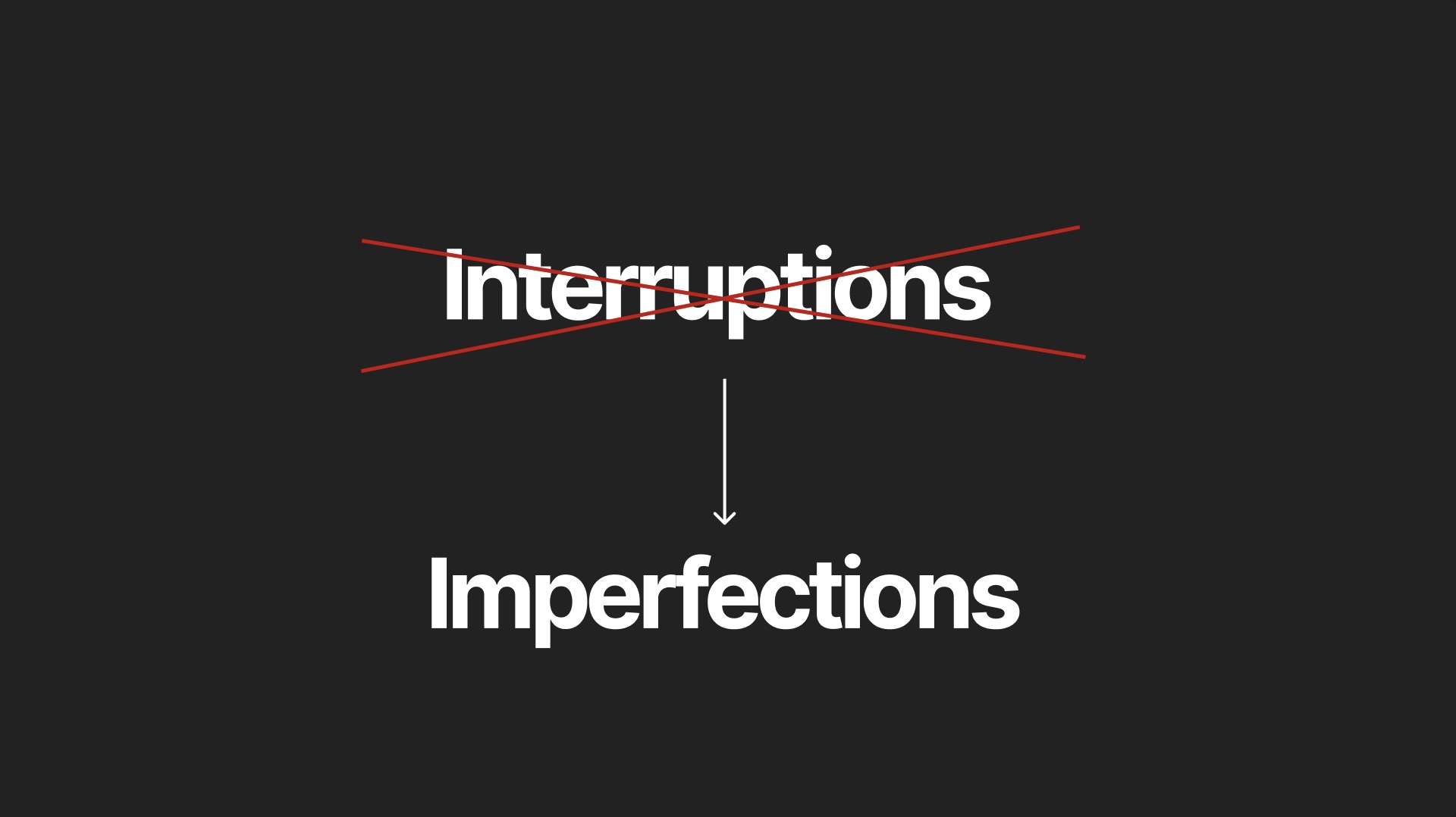
Consultation and Reframing: From Interruptions to Imperfections
This week was more about thinking than making. I went into the consultation still holding on to the idea of interruptions. After the funnel, iceberg and HMW exercises, and after talking it through with my lecturer, the frame shifted. Imperfection felt like a more accurate centre for what I have been exploring. It describes something deeper and more structural, not just a moment of break or pause.
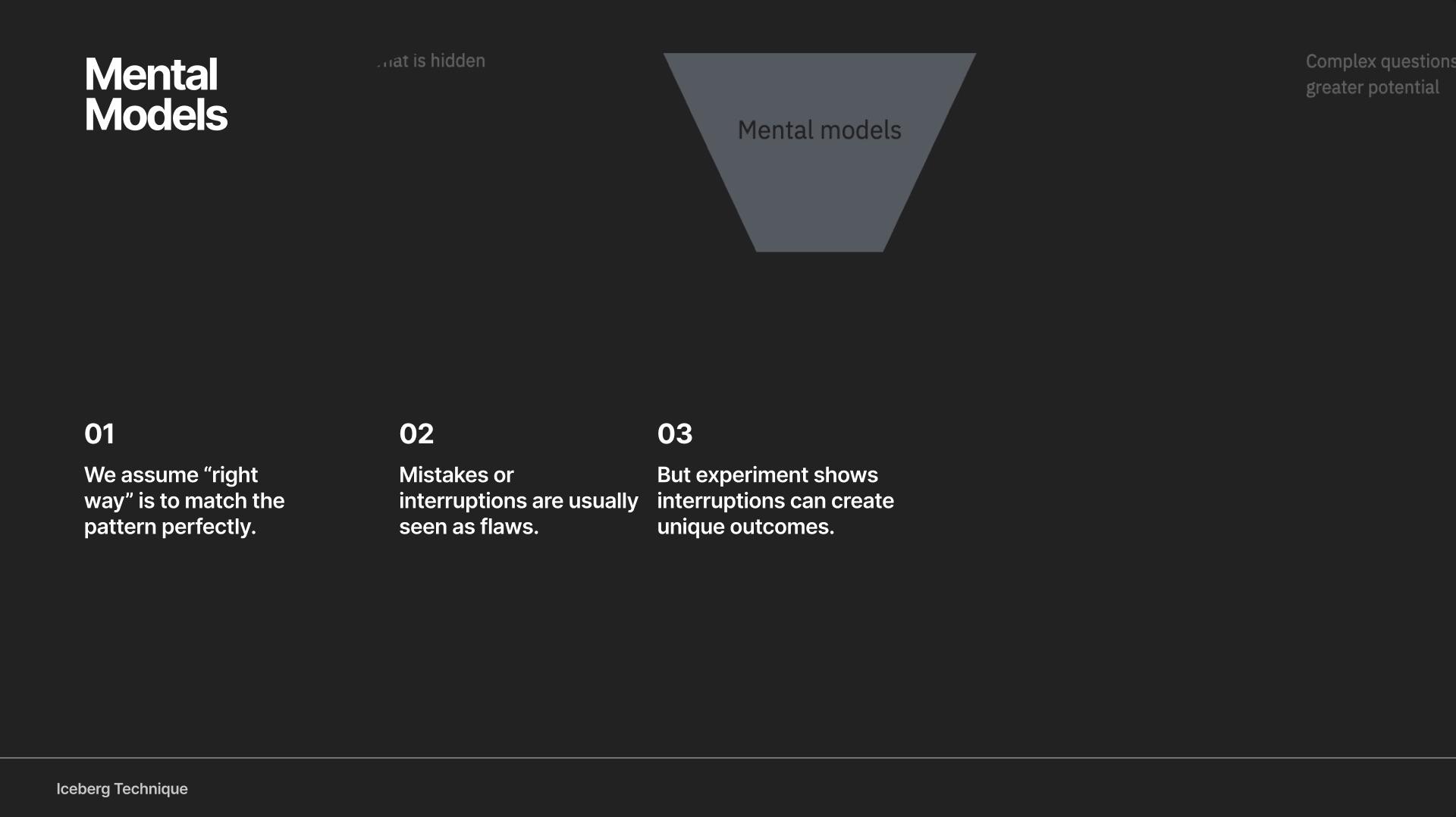
Funnel
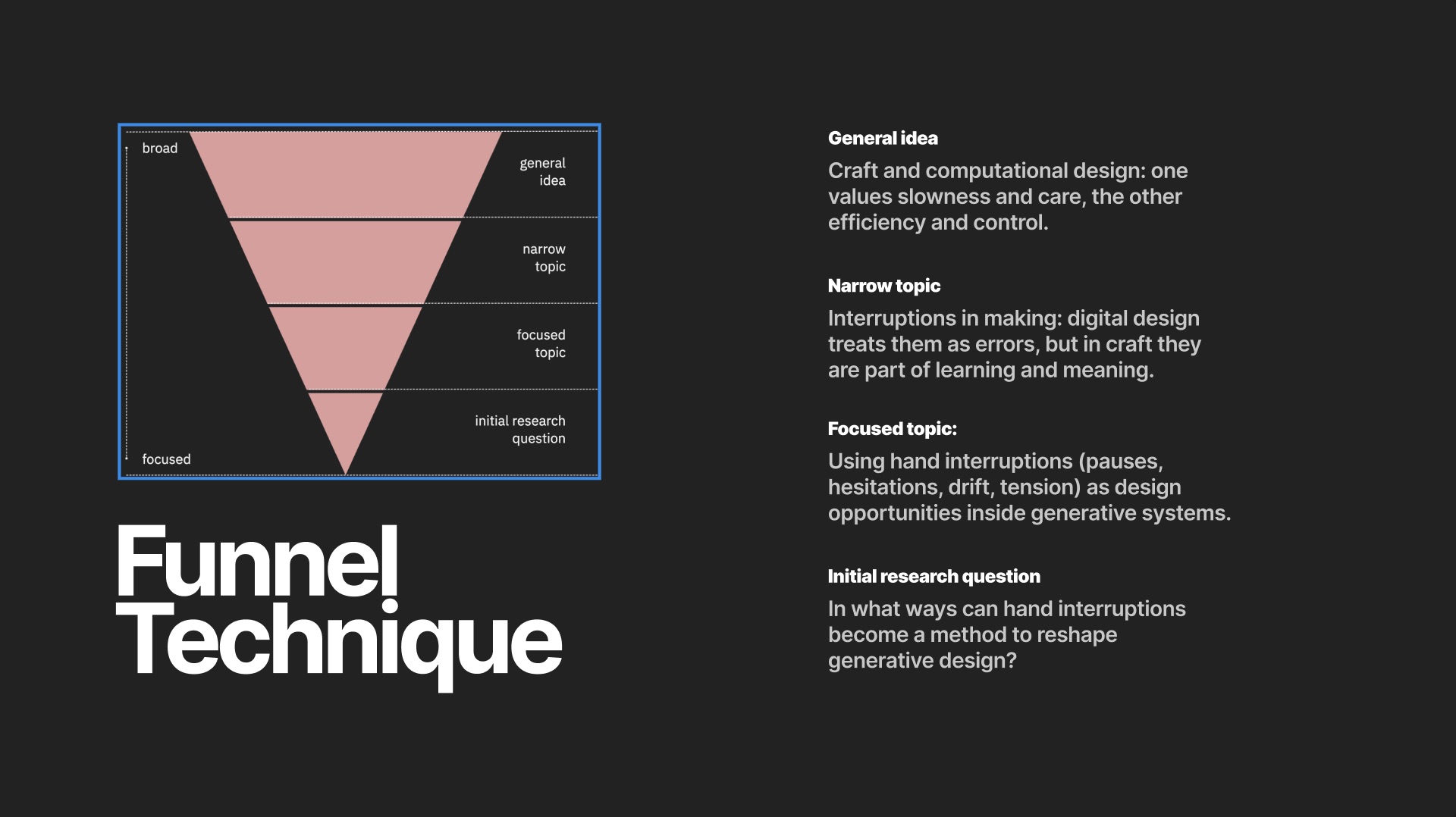
Moving from craft and code, toward a clearer question: how can imperfection be a method in generative design.
Iceberg
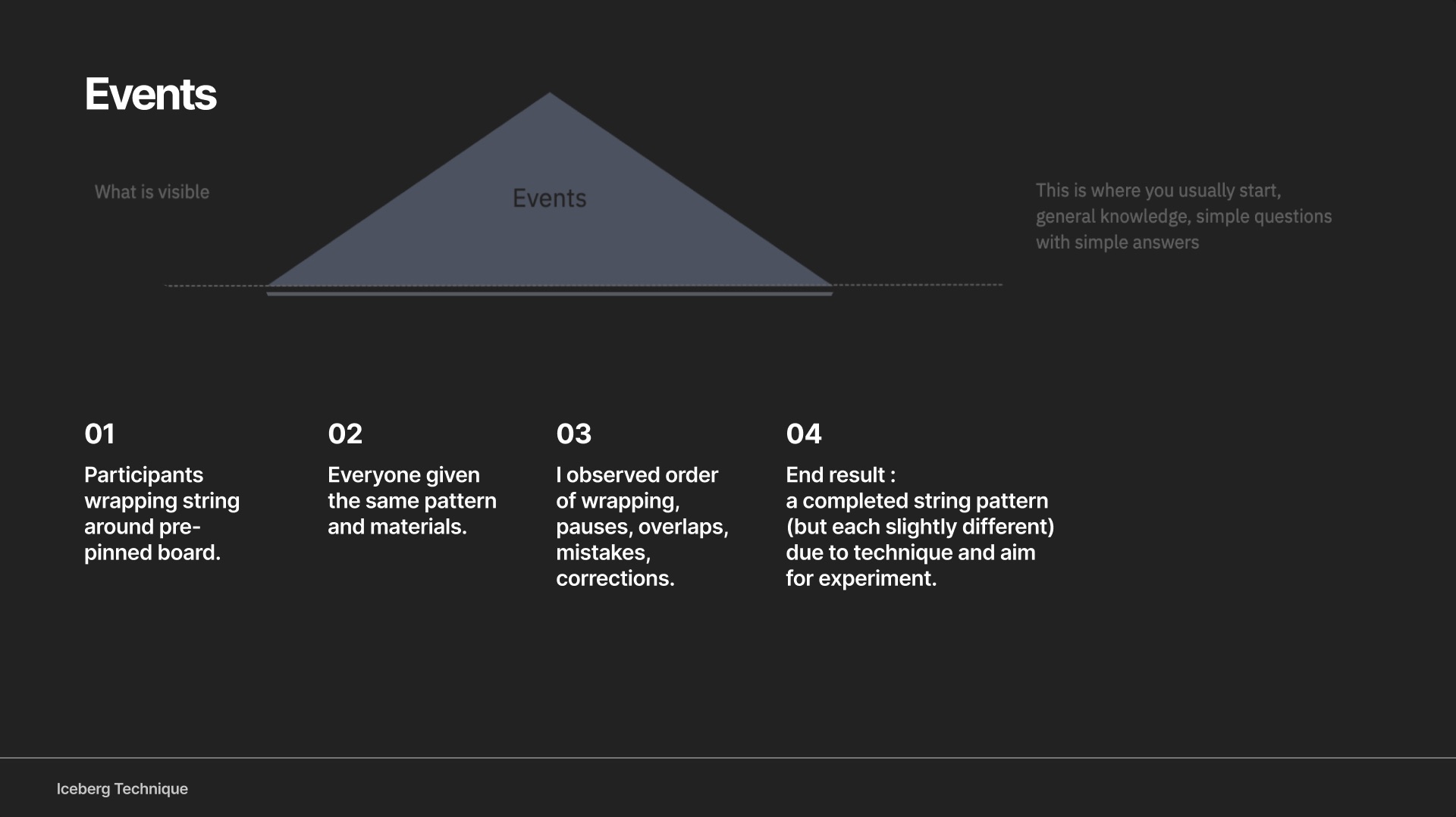
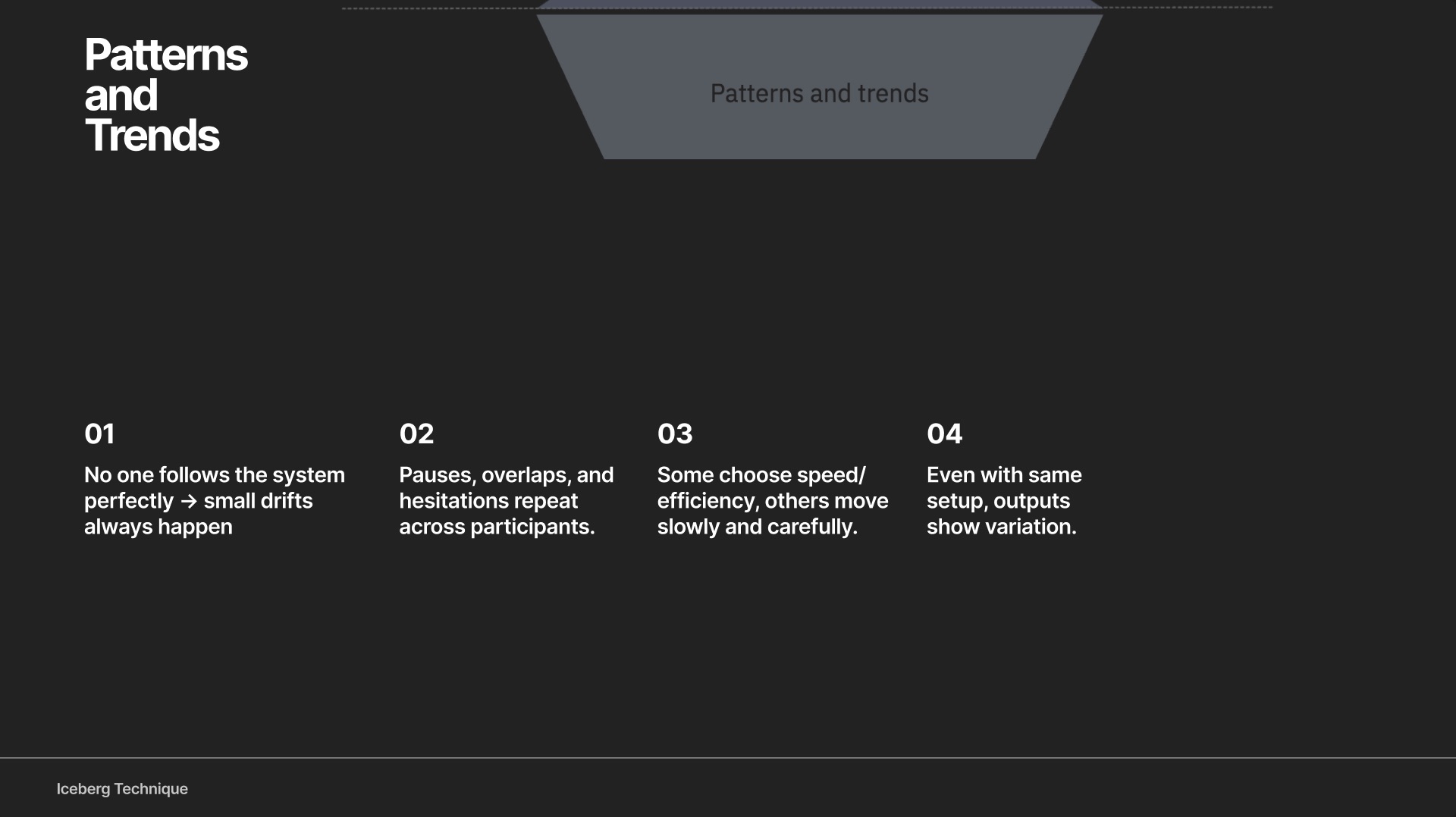
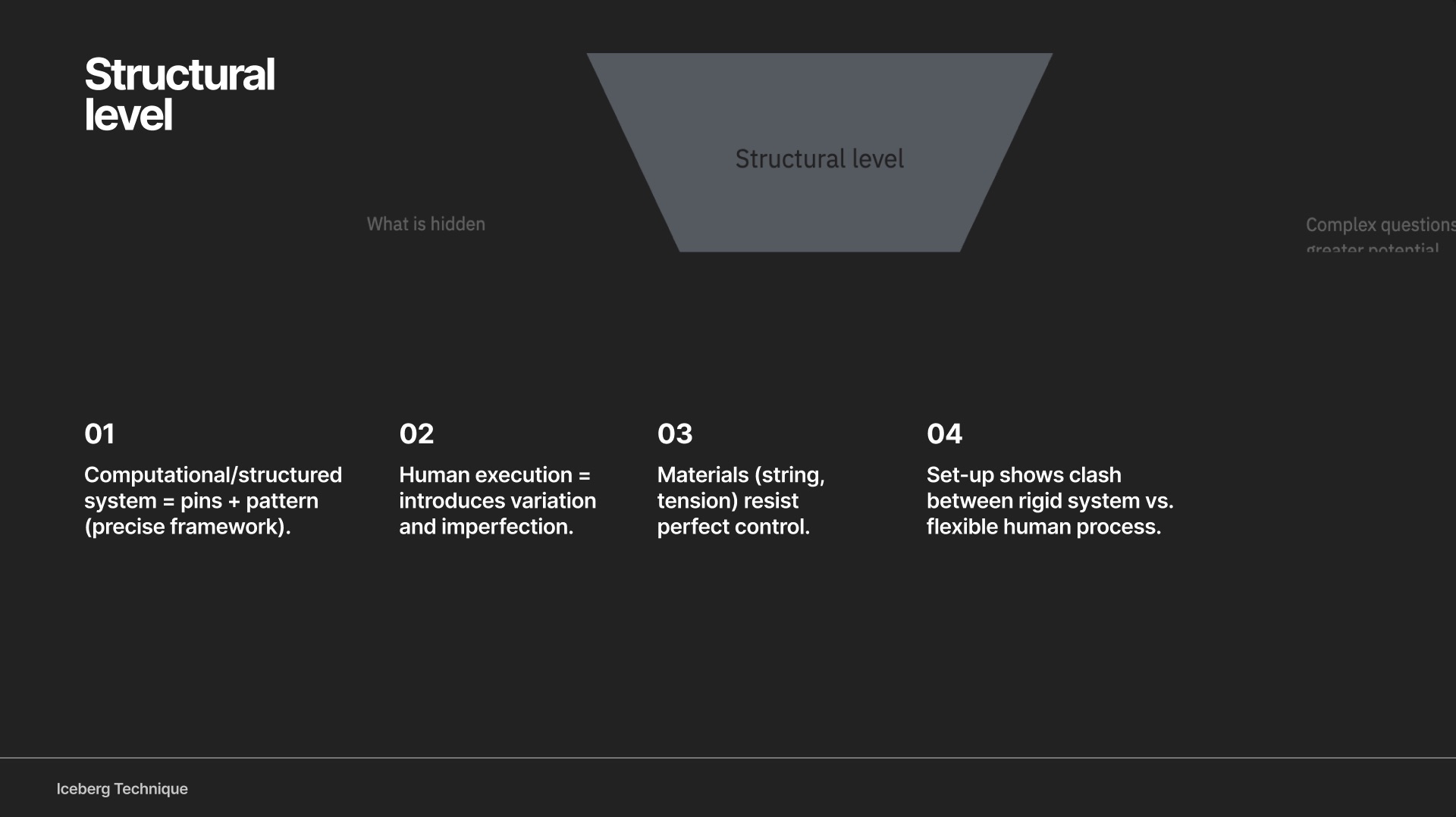
Events, patterns, structures, and the belief that systems must stay neat, efficient, and controlled.
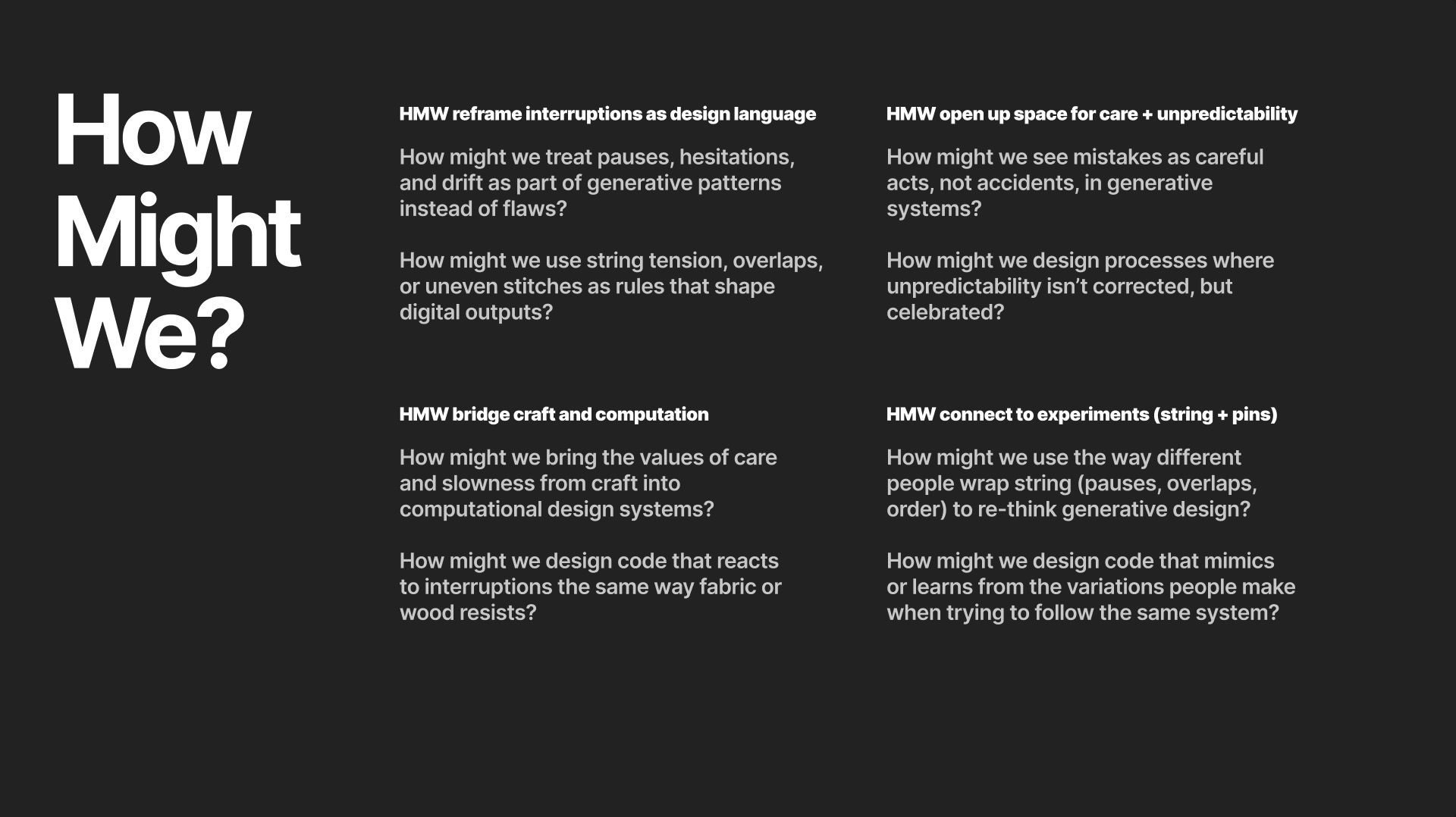
HMW
Turning insights into prompts about care, resistance, and visible hesitation, ready to test in practice.
[ Funnel Technique ]
Narrowing the question
From broad field to clearer focus
The funnel helped me narrow my thoughts. I moved from the broad relationship between craft and code, into questions about precision, before landing on this: how can imperfection be a method in generative design. Writing it out made the direction feel clearer. I realised I had been circling it for weeks without naming it.
[ Iceberg Exercise ]
Seeing beneath the surface
What sits under the neat surface
Mapping my project through the iceberg showed me what sits beneath the surface. Events were small things in the making process, like overlapping thread, slight tension mistakes, and small hesitations. Patterns came from how materials behaved, from thread sagging and pins shifting to surfaces resisting. Structures revealed the relationship between rigid systems and the flexible hand. At the bottom were the assumptions I was carrying, the belief that systems should be neat, efficient, and fully controlled.
This made me realise that what I value is actually the opposite. I am drawn to moments where a system bends or slips a little, where it shows signs of being worked through by a hand.
[ How Might We (HMW) Questions ]
Care, not flaws
How might I read mistakes as careful acts rather than failures to erase.
Material resistance
How might I design code that resists like fabric, with tension, sag, and drift.
Visible hesitation
How might hesitation or incompletion stay visible in the final outcome.
[ What Feedback Revealed ]
From interruption to imperfection
Defining what I am really looking at
The key feedback was to shift from interruption to imperfection. Interruption felt too broad. Imperfection gave me a clearer frame and a stronger link to my making. Another point was that imperfection in code cannot just be randomness. It needs to feel embodied, like something influenced by the hand. A slight deviation should feel intentional, even if it comes from a system.
The example of a machine trying to draw a square but ending up with a heart captured that idea well. Something off, but meaningful. The real question my lecturer left me with was simple: what does imperfection mean in my practice, and how do I show it across both material and digital processes.
Sharper frame
Shift from interruption as a catch all toward imperfection as the main thread.
Embodied, not random
Imperfection cannot just be noise. It needs its own logic and feel.
Authorship
A machine that tries to draw a square, but ends up with a heart, still says something about how it works.
[ What I Realised ]
Connecting the readings
Imperfection as the thread
This week helped me see that imperfection is the thread that connects my work. Sennett reminded me that imperfections can reveal learning. Reddy showed how resistance creates meaning. Tsaknaki framed care as something that shows up in small deviations. These ideas sit more comfortably under imperfection than interruption, which confirmed the shift for me.
Sennett
Imperfections as traces of learning
Imperfections are not just errors to correct. They map decisions made over time and show where someone has tested, adjusted, and tried again.
Reddy
Resistance that carries meaning
Material resistance does not simply get in the way. It shapes the outcome and gives it character, which connects strongly to how I read the string and pins in my experiments.
Tsaknaki
Care in small deviations
Care can appear as slight misalignments, repairs, and soft adjustments. Under imperfection, these become values rather than problems to smooth out.
[ Reframe to Imperfection ]
Anchor
Imperfection as method
The consultation anchored the project in a way that finally feels aligned with how I work. Imperfection gives me space to design experiments where quirks, glitches, and deviations are treated as part of the system, not errors to correct. They become signs of personality and authorship, whether they come from a hand or from code.
[ Moving Forward, Question 1 ]
What makes an imperfection meaningful?
I want to understand which deviations actually add character, and which ones just distract. There’s a line between “alive” and “sloppy” that I need to learn to see.
[ Question 2 ]
How close can code get to the hand?
The hand hesitates, pauses, and corrects itself. I’m curious how much of that can be translated into digital behaviour without pretending to be human.
[ Question 3 ]
Can a system show temperament?
If I keep framing imperfection as personality, then what does a system’s “temperament” look like? Does it come from rules, materials, timing, or something else entirely?
[ QQuestion 4 ]
Where does control help, and where does it flatten?
Over-controlling the work makes it behave too neatly. Letting go introduces drift. I need to figure out where that balance actually sits for this project.
[ Question 5 ]
Translating imperfection across materials
Thread, pins, and code each “misbehave” differently. How can I translate the qualities I value in physical making into digital logic without forcing a direct copy?
[ Question 6 ]
What happens when things break?
Week 5 will look at conductive thread, cutting, snipping, and repair. I want to see how breakage changes the behaviour of a system, and whether repair can carry its own aesthetic.