WEEK 3
EXPERIMENT 01
String Pattern Recreation
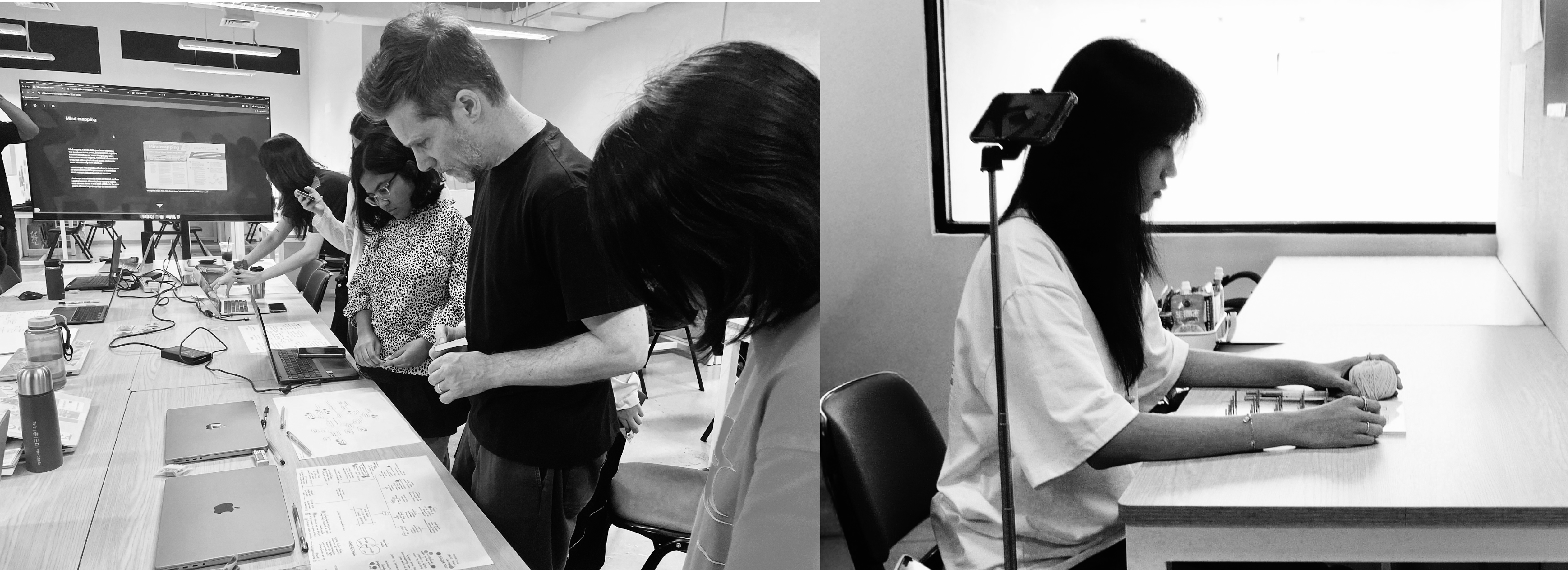
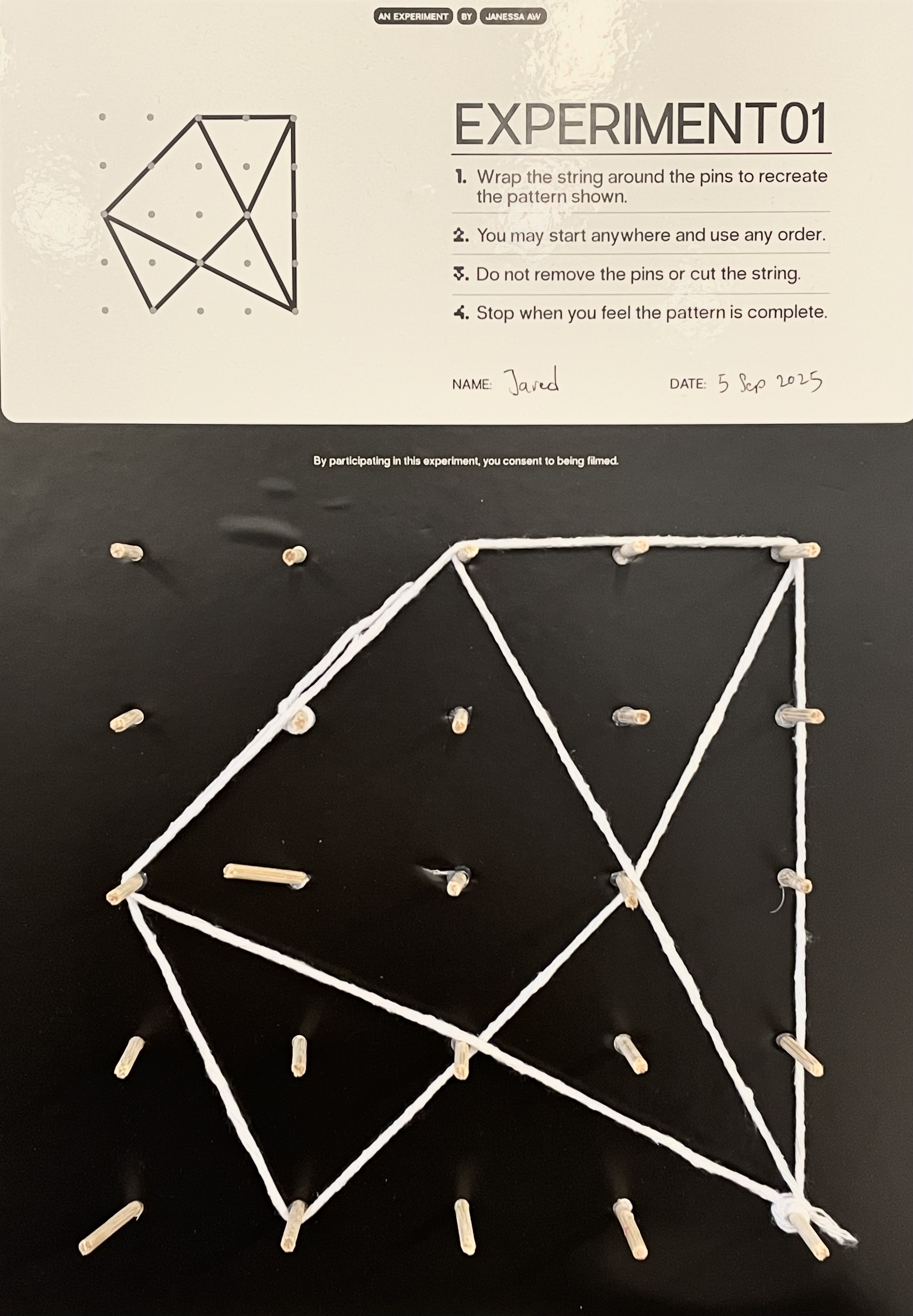
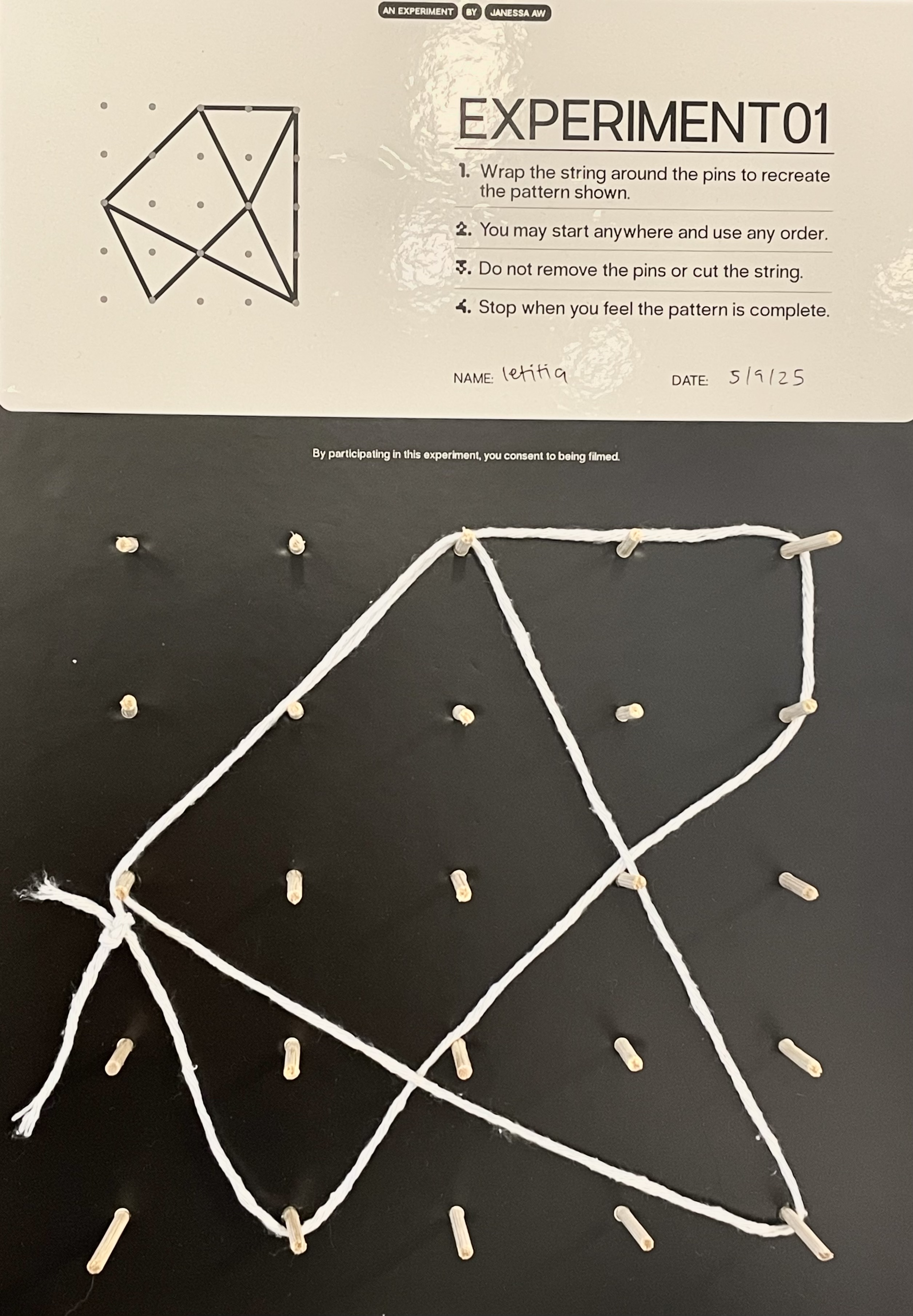
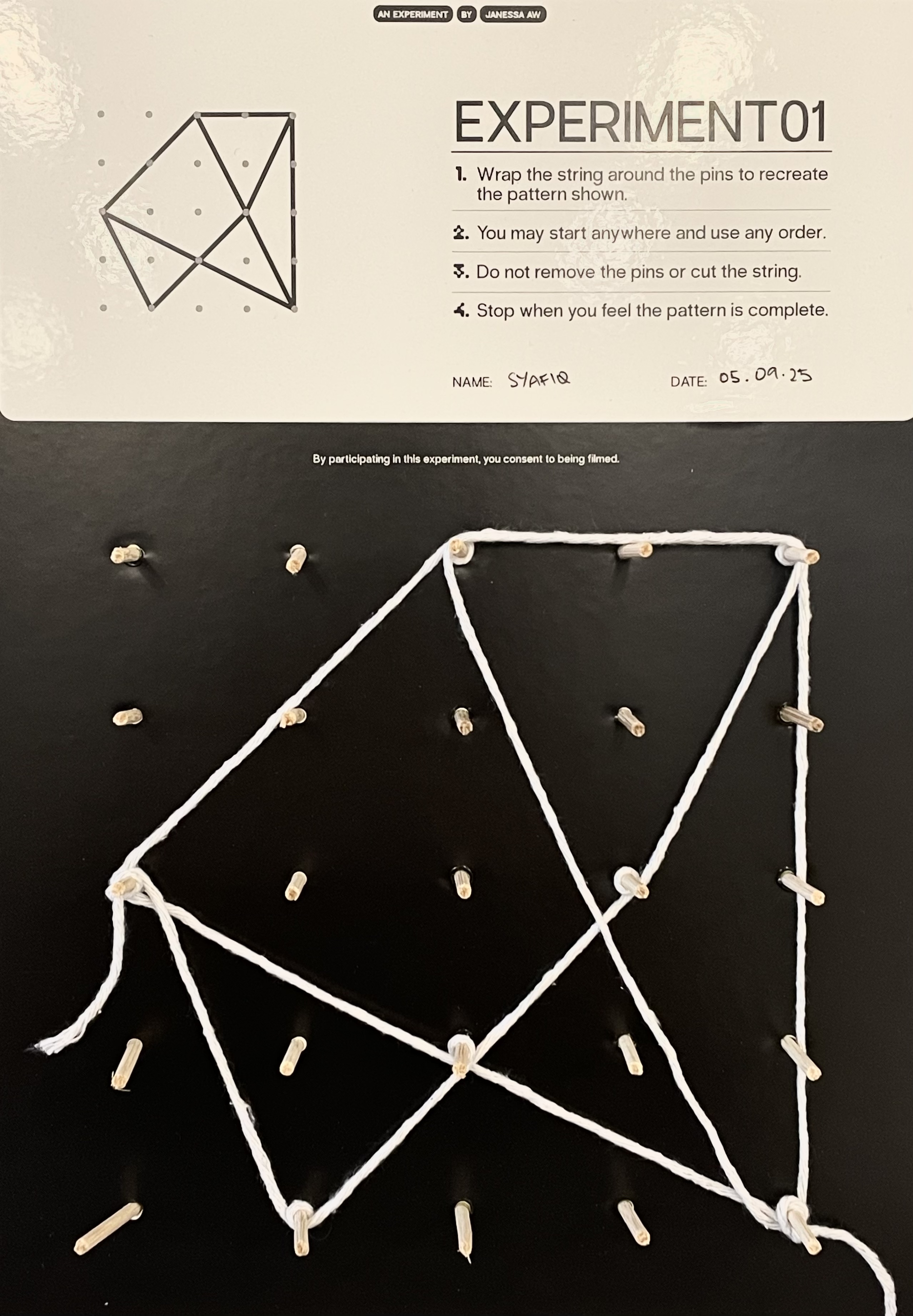
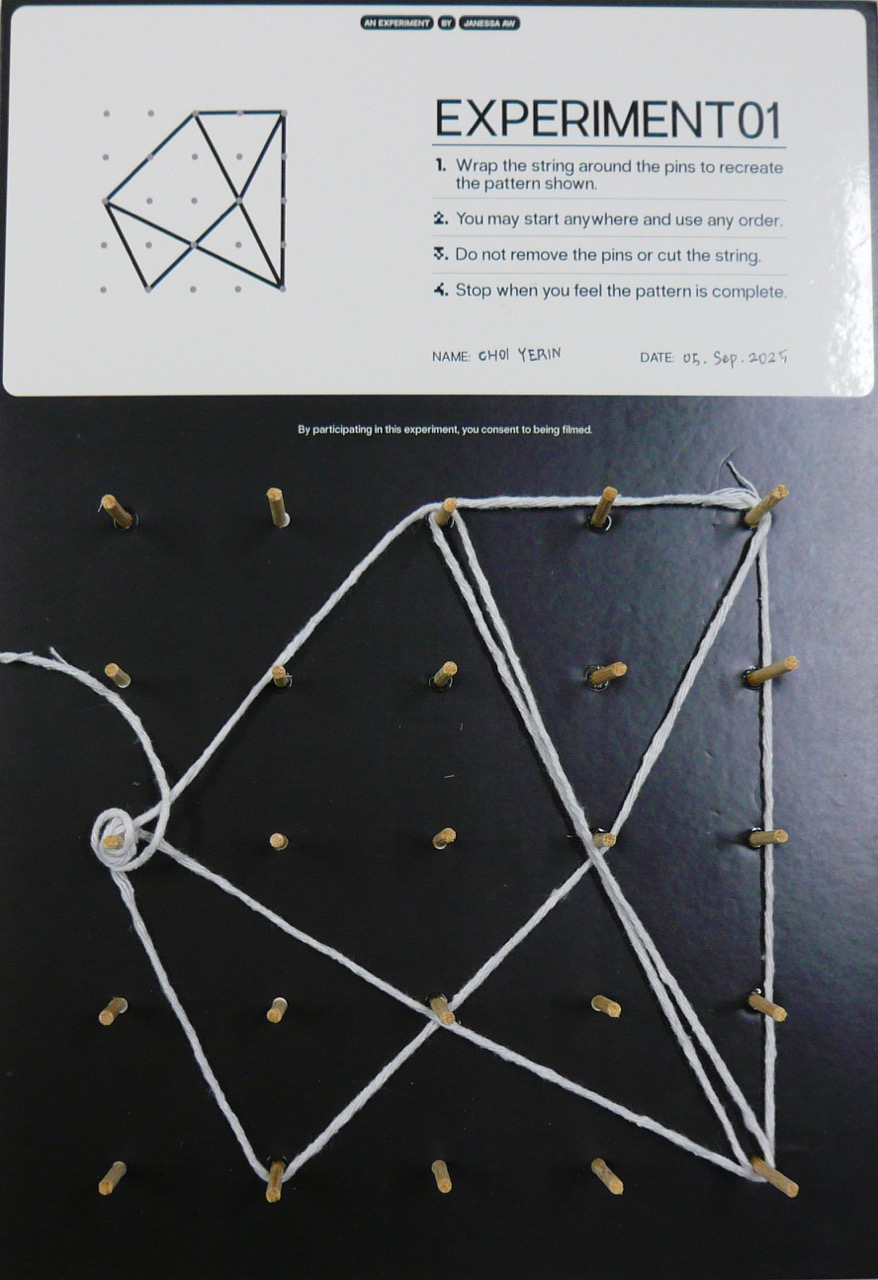
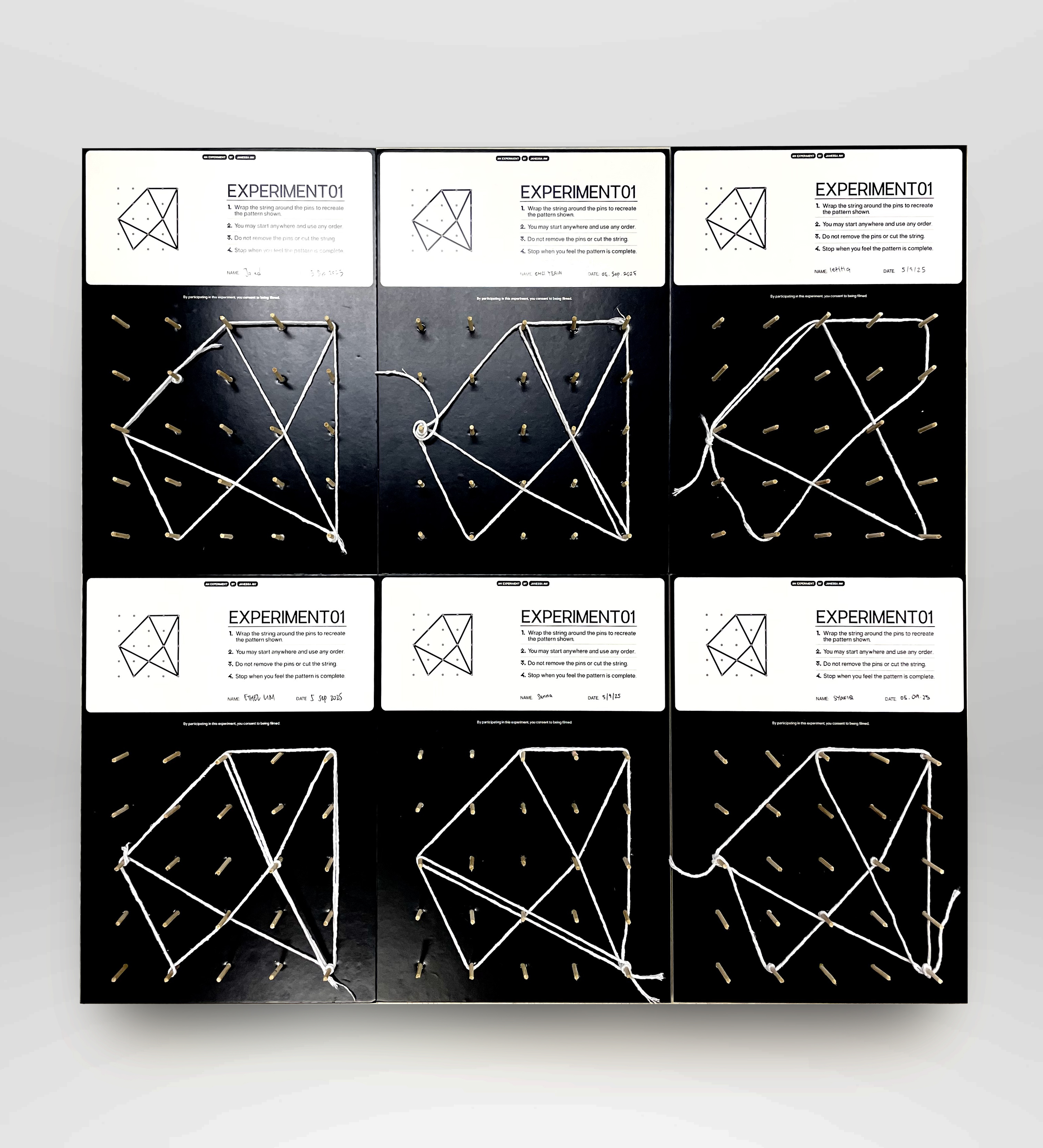
Before running this experiment, we did a class mindmap activity to surface what others noticed in our work. After class, I conducted Experiment 01: What happens when six different hands try to remake the same “perfect” pattern with string? Could imperfection reveal individuality instead of error? The test here is simple: a neat pattern remade under the same rules, negotiated by different rhythms and resistances.
Aim
Probe if “error” is actually the feature that makes outcomes distinct, personal, and alive.
Setup
Board, fixed pins, one string, shared rules, timed. Observed with a template.
Capture
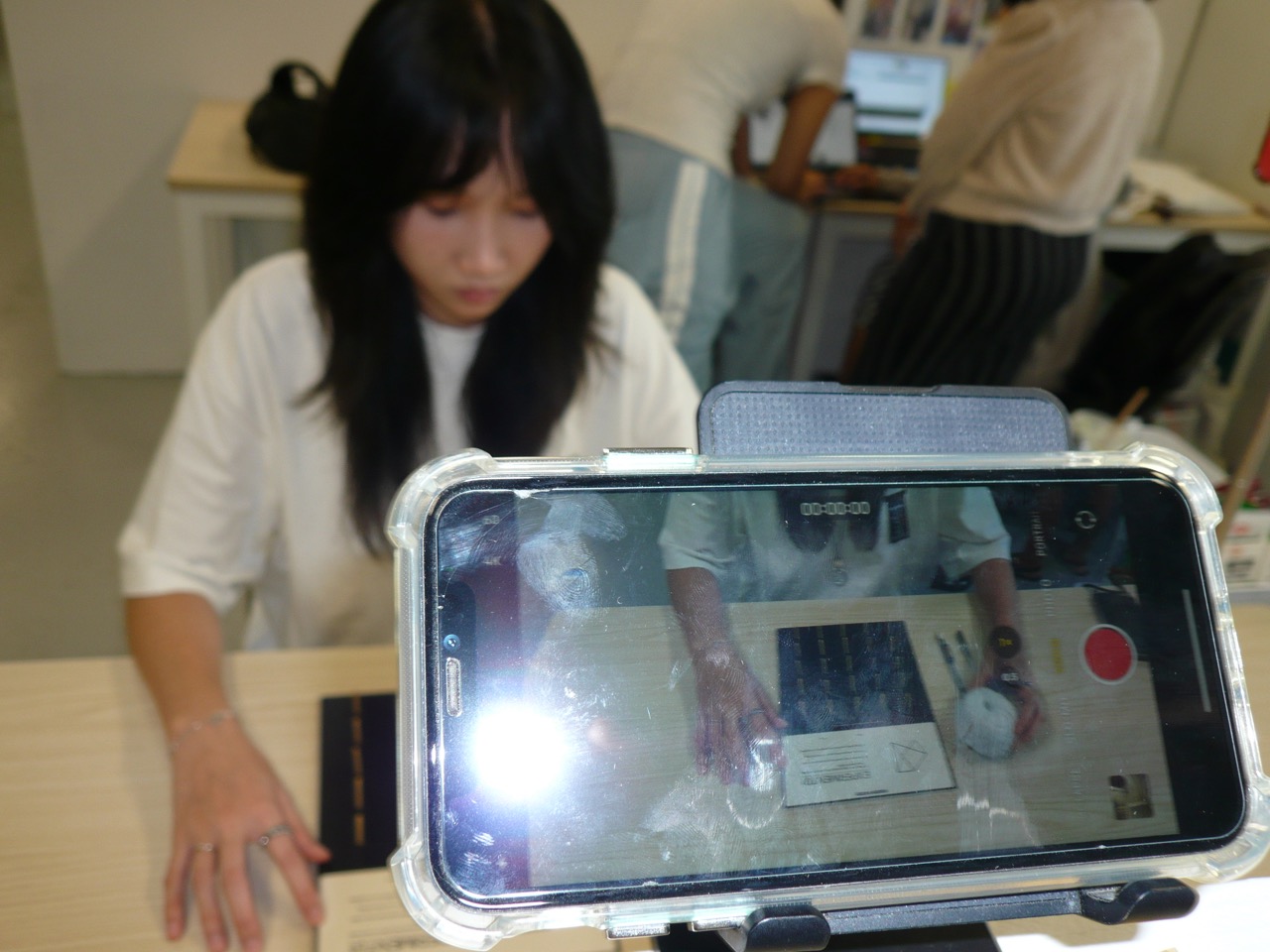
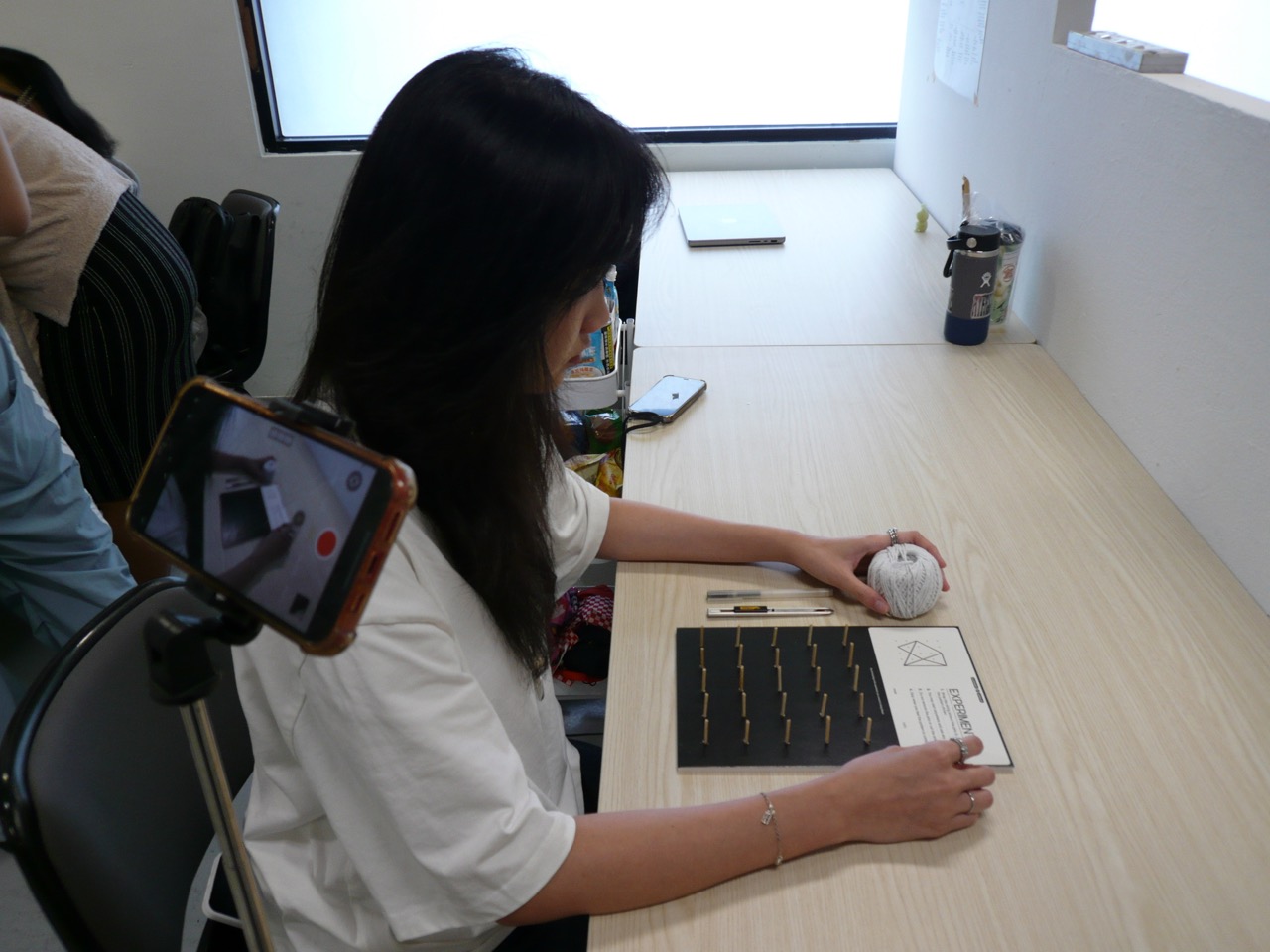
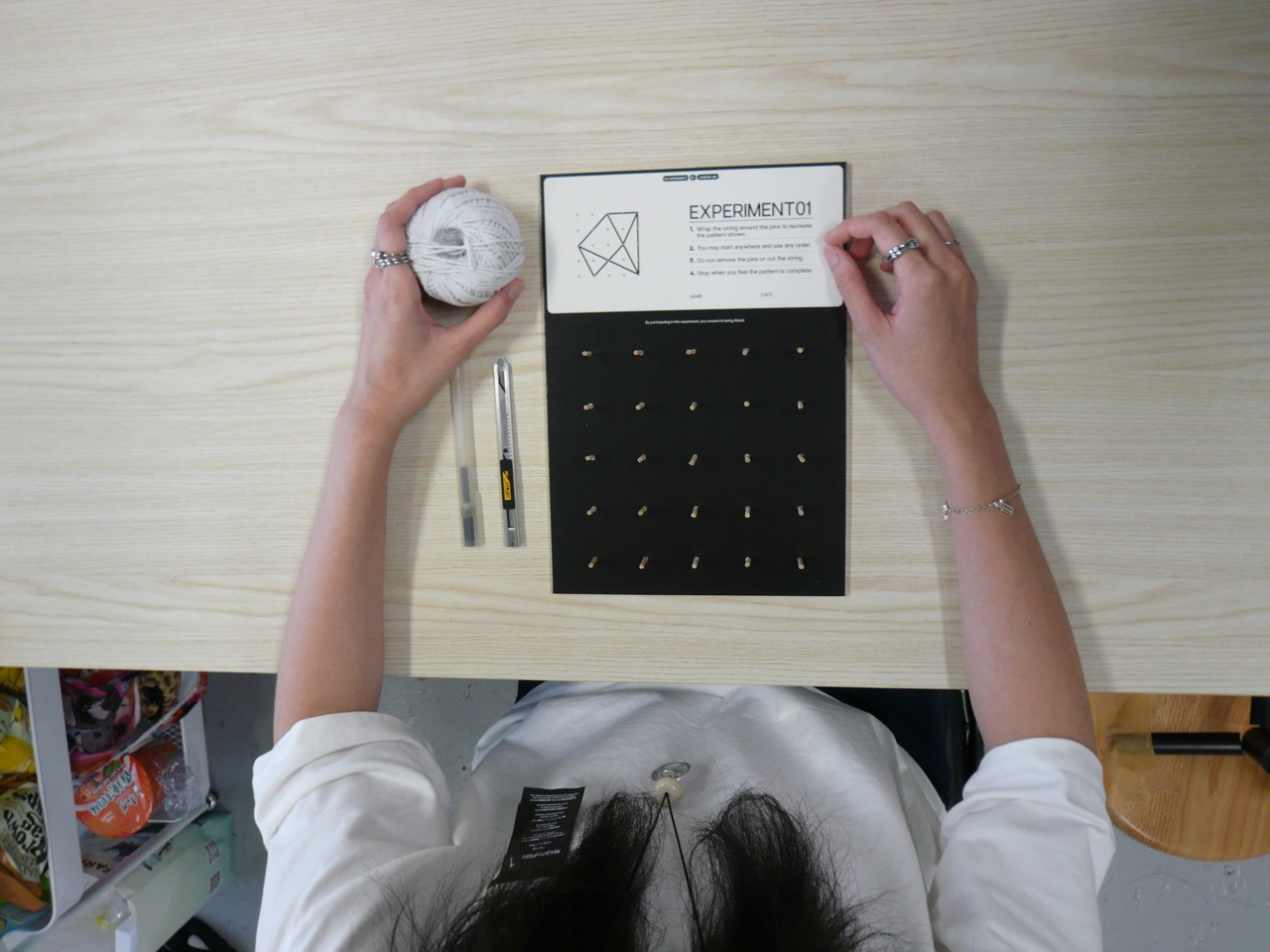
Two angles filmed (top and side) plus notes on strategy, tension, pauses, and edits.
[ What Happened in the Process? ]
Class activity
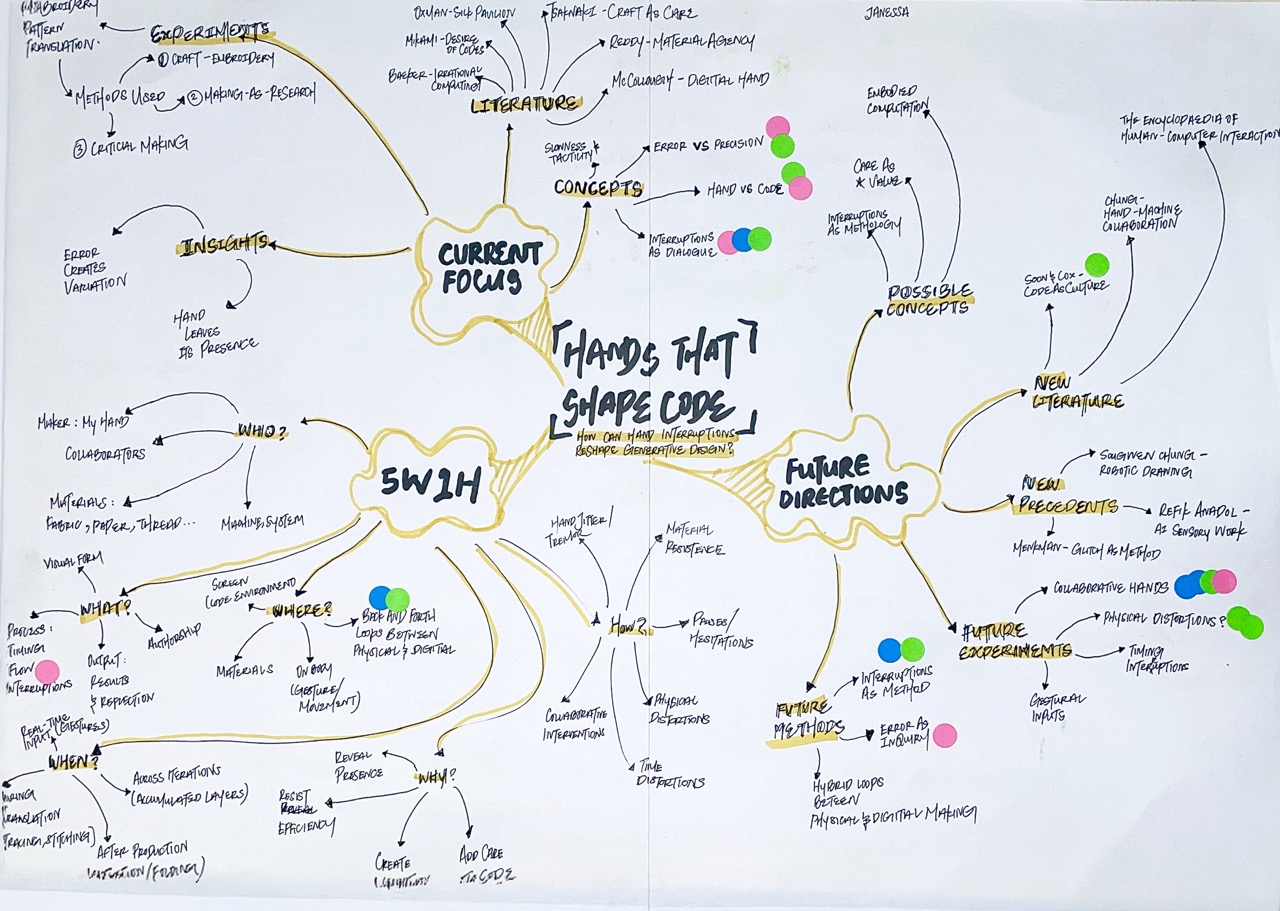
Mapping my research direction
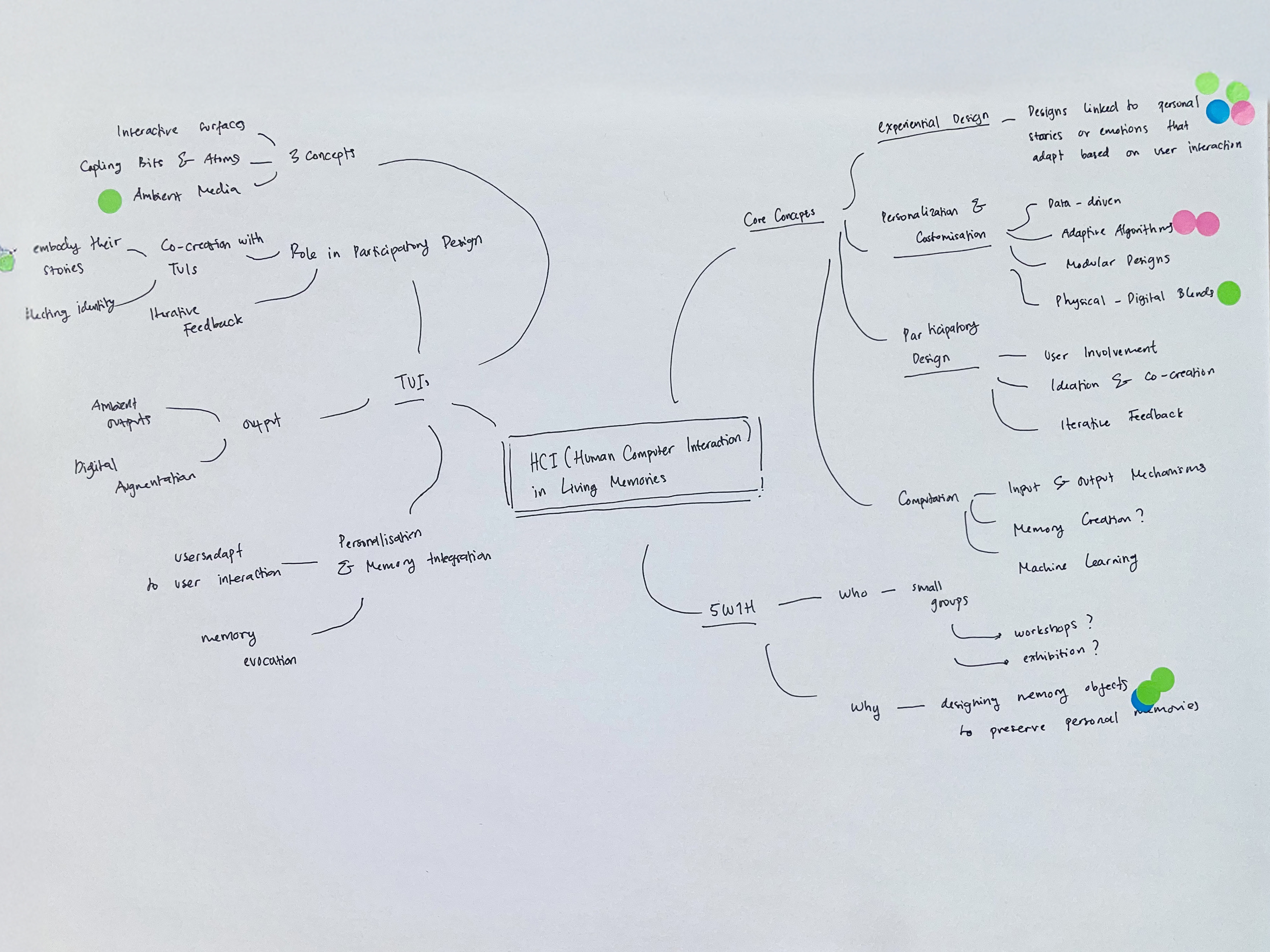
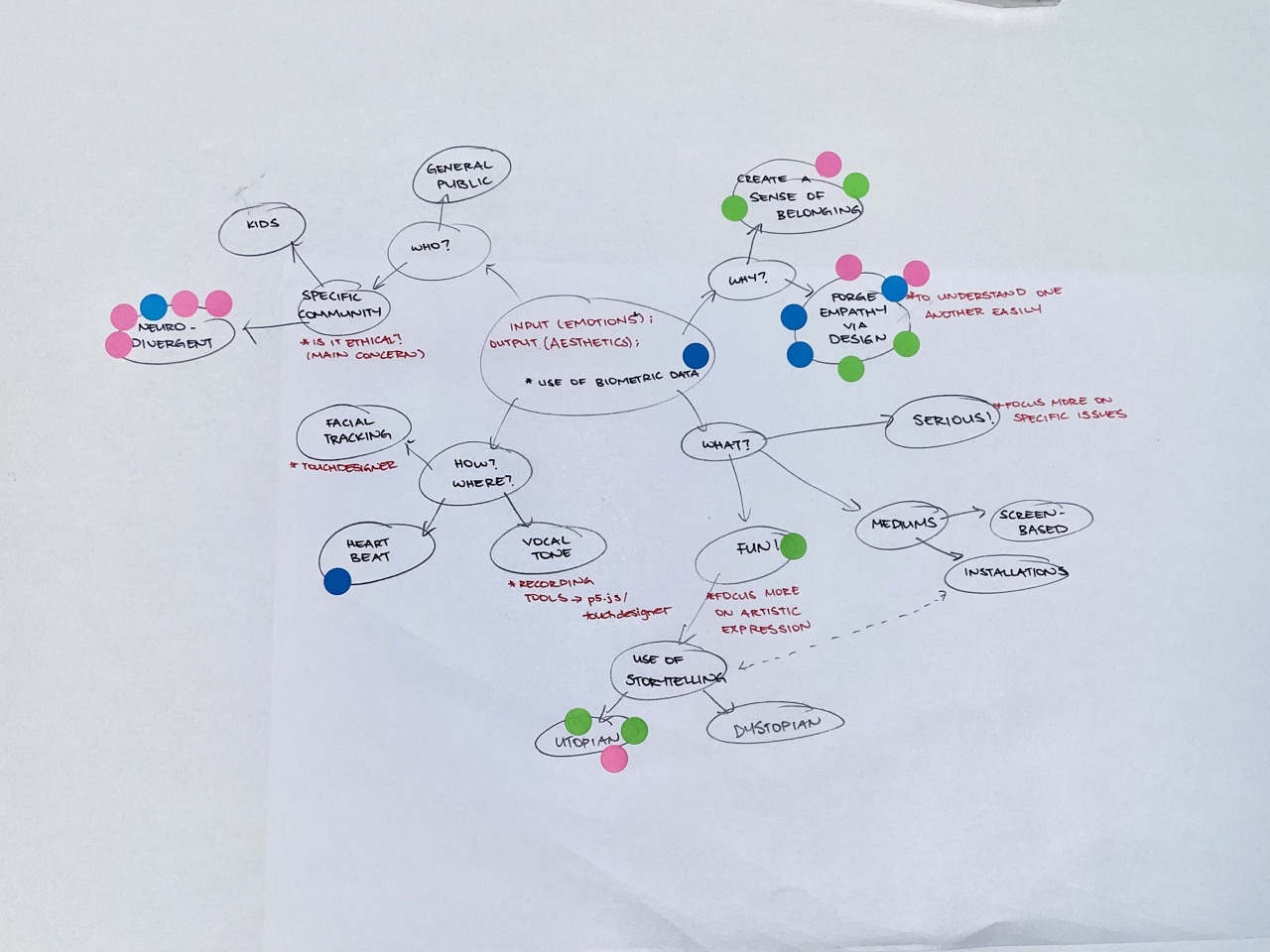
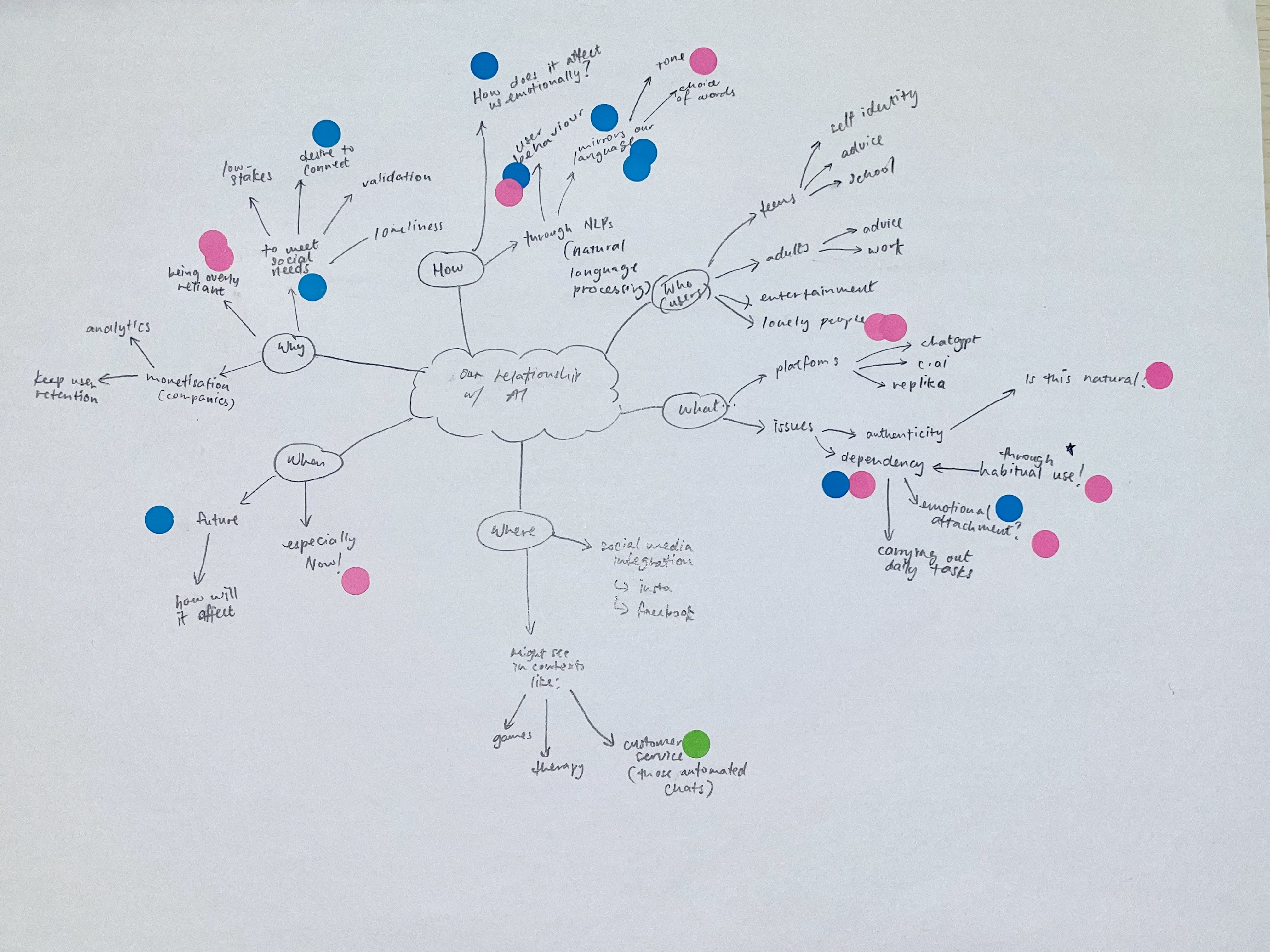
Andreas asked us to create a mindmap of our current research direction. After that, we walked around the room to look at each other’s maps and placed stickers on the points we found interesting.
When I came back to mine, four points had stickers:
• collaborative hands
• error vs precision
• back and forth loops between physical and digital
• interruptions as dialogue
These were ideas I already cared about, but seeing my peers highlight them helped me understand what was coming through clearly in my explanation.
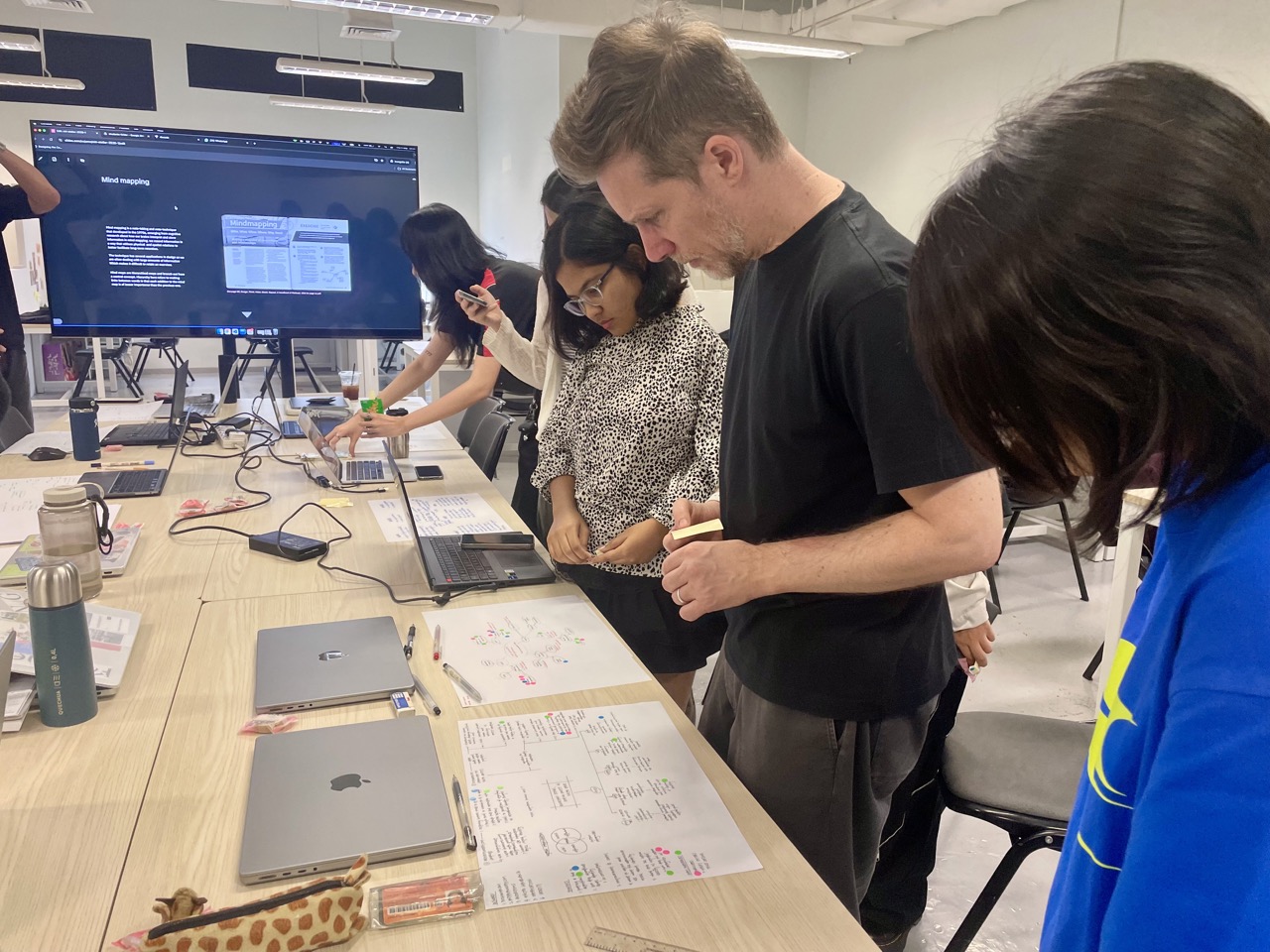
Seeing others’ directions
How my classmates frame their work
Looking at everyone else’s maps made me realise how differently we each frame our work, even when our topics overlap. Some emphasised context and audience, others foregrounded methods, tools, or emotional drivers. It helped me see my own direction with more distance instead of being stuck inside it.
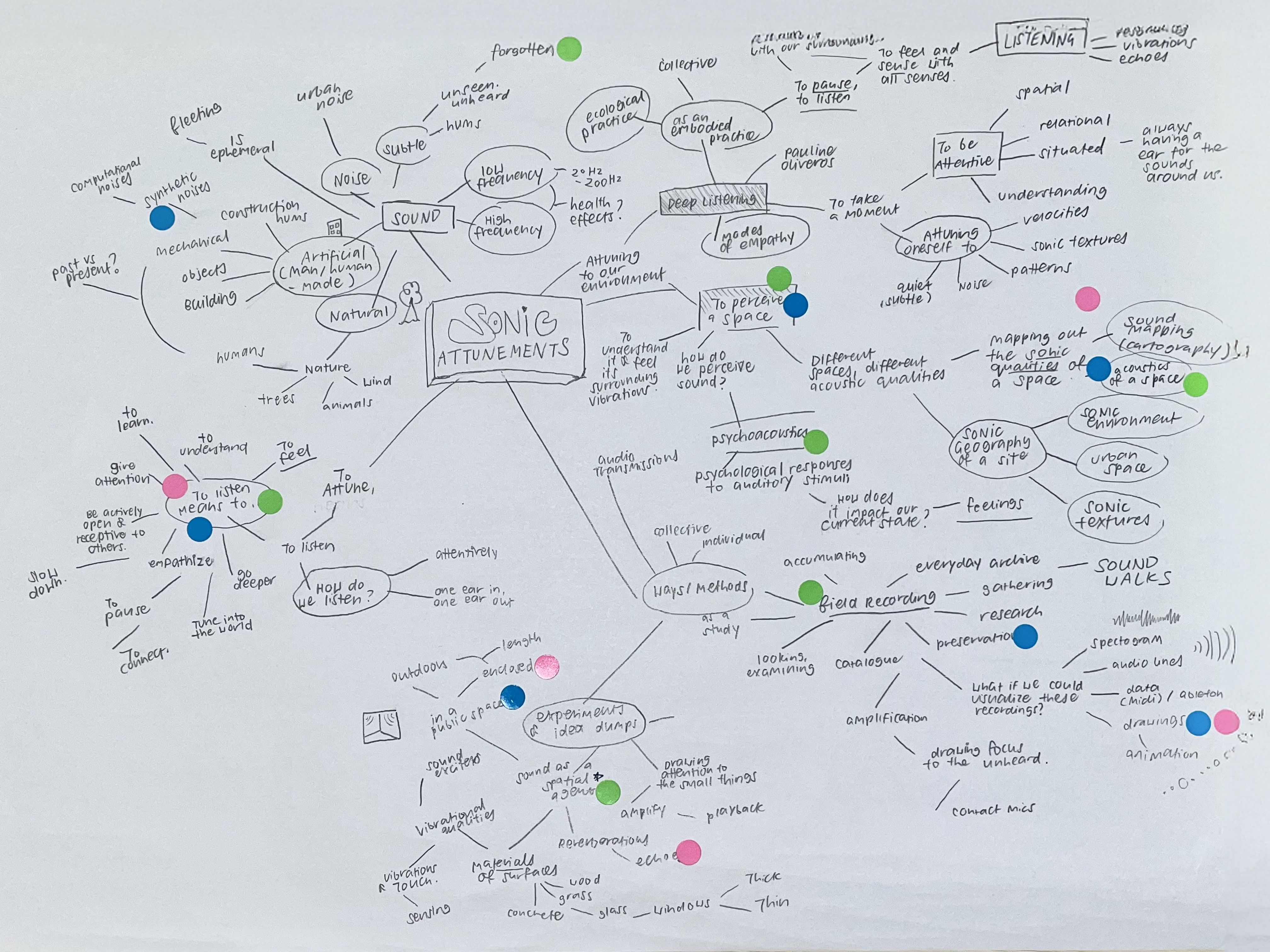
Reflection
Stickers as signals of what resonates
My classmates were drawn to the places where the hand meets the system. Seeing the stickers cluster around those points showed me that the human side of my project is what resonates most. It also confirmed that I should keep working in the in between spaces: physical and digital, control and error, instruction and interpretation.
Next steps
• Write short notes to clarify what each sticker point means for my direction.
• Start narrowing down by choosing one pathway to deepen first.
• Think of experiments that can answer these enquiries directly.
Capture method
Two angles plus live note-taking
Filmed from top-down and side while standing behind the overhead camera to trigger the timer and take observation notes. Most participants finished within around 2 minutes; Leticia did not complete.
Strategies and resistance
Different approaches, one system
Starts varied (corners, hardest part first, left to right like reading). People tried to minimise overlaps or fill details before outlines. Soft string resisted: tension had to be balanced, coils slipped, slack and knots forced mid-course adjustments.
Outcomes
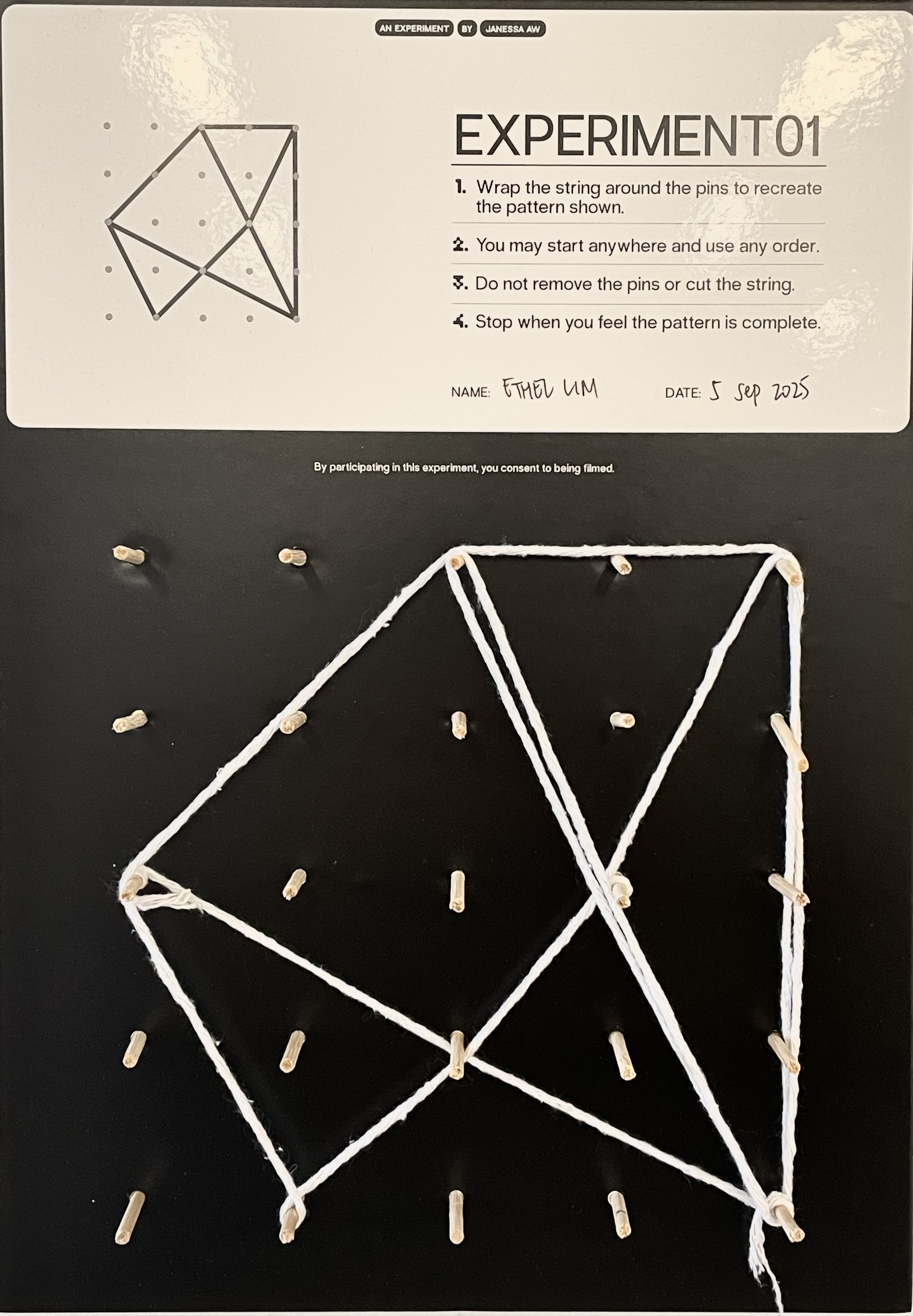
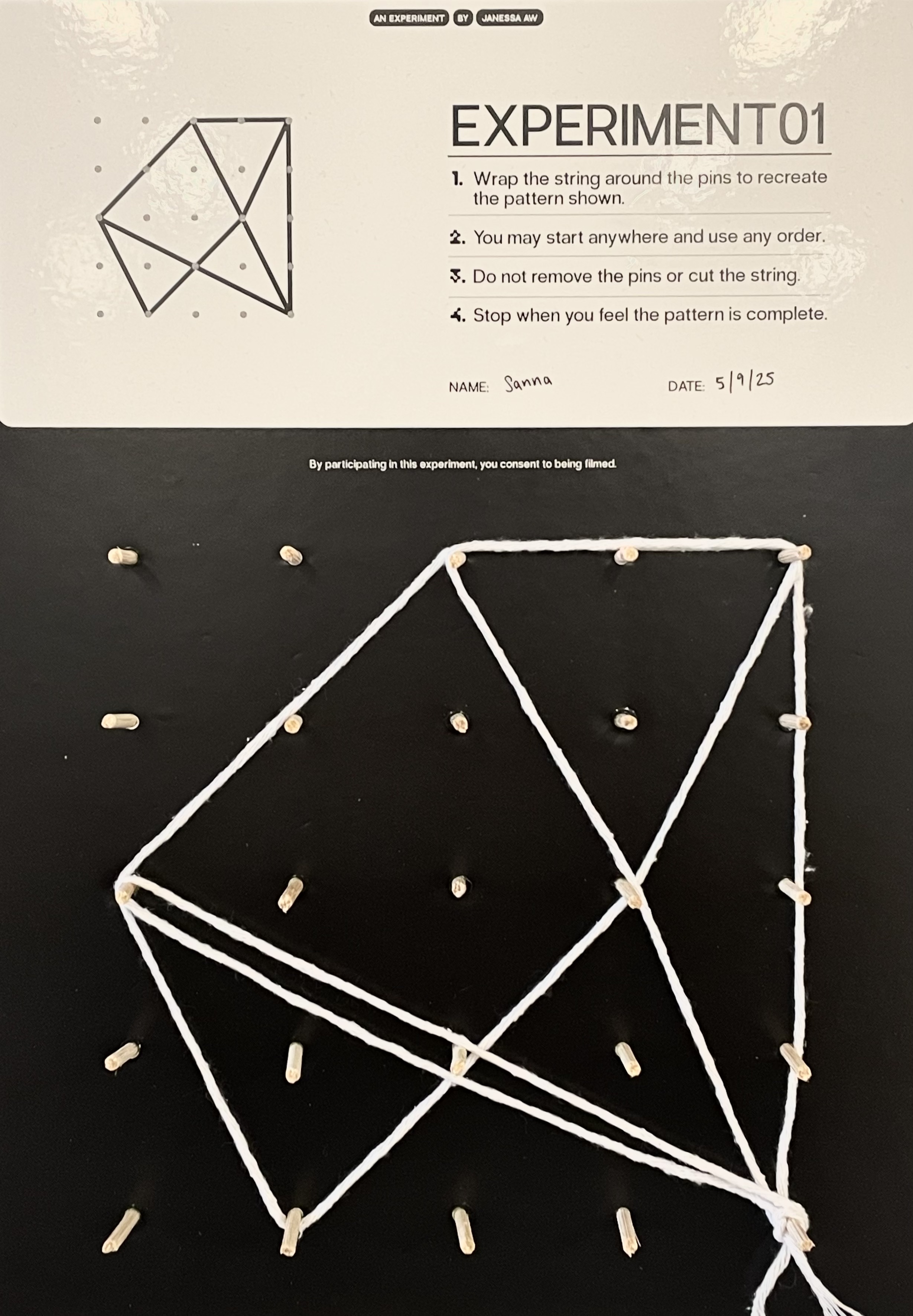
No two results alike
Some dense, some loose, some precise, some sagging. Starting points “authored” the form. Leticia’s incomplete version challenged the assumption of completion. Side by side, they read as different authorships, not one system’s errors.
[ Participant Feedback Highlights ]
Yerin
Started with the hardest part; slowed by tying; wished for fewer repeated lines.
Jared
Chose top-left start to minimise overlaps; uneven start and end was frustrating.
Leticia
Stressed by timing and shifting board; would analyse more before starting; did not finish.
Syafiq
Went left to right like reading; struggled with tension and overlap; wished to cut earlier.
Sanna
Started bottom corner; slowed when noticing overlaps but kept approach.
Ethel
Analysed to avoid repetition; mismatch between diagram depth and board; would start at edges next time.
[ What I Realised ]
Material agency (Reddy)
The string pushed back
Tension, sag, and knots shaped results as much as the participants did.
Iteration (Sennett)
Micro-decisions surfaced
Testing, pausing, adjusting, slowness made their choices visible.
Care (Tsaknaki)
Attention embedded in making
Tightening coils and avoiding overlaps read as gestures of care.
Critical making (Ratto)
Process over accuracy
The value was in exposing systems of choice, hesitation, and resistance.
[ Why It Matters to My FYP ]
From rules to authorship
Interruption as presence
Side by side, results were not about accuracy. Same rules, different authorships. If code is the rule system, string is the site of resistance, and the hand is the interpreter. Interruption becomes proof of presence.
[ Insight 1 from Experiment 01 ]
Variation is good sign
Seeing the six outcomes together made it clear that the differences weren’t mistakes. They showed how each person negotiated tension, sequence, and comfort with the material. Variation became a record of how the hand adapts rather than a sign of inaccuracy.
[ Insight 2 from Experiment 01 ]
Starting points shape everything
The first move carried a lot of weight. Whether someone began in a corner, tackled the toughest area first, or moved like reading, that early choice set the whole rhythm. It showed me how structure can emerge from small, almost instinctive decisions.
[ Insight 3 from Experiment 01 ]
Material pushes back
The string didn’t behave consistently. Slack, slipping, and knots slowed people down and sometimes forced them to change their plan. The outcomes made that visible. The material wasn’t passive, it co-shaped the final form.